Rasasindooram- Benefits, Indication, Ingredients, Usage, Dosage, Diet, Contraindications, Research papers

Rasasinduram capsule is an Ayurvedic medicine that provides overall health and immunity and is used in diseases that need emergency management. This tablet or powder contains more mineral ingredients and fewer herbs. This medicine should only be taken as per the direction of a physician.

RAS SINDOOR Benefits

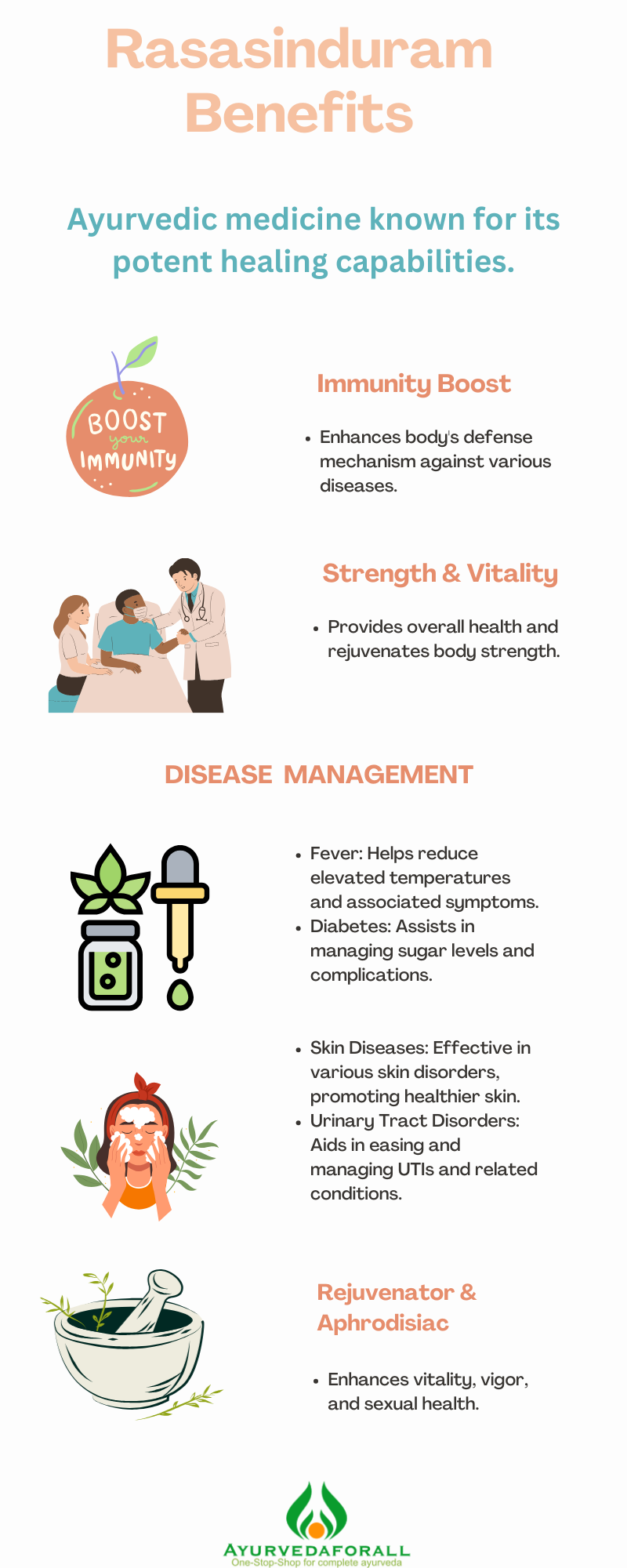
  • This medicine can be given as an immune booster for many diseases.
  • It provides body strength and overall health
  • This medicine is particularly administered for diseases like fever, diabetes, skin diseases, urinary tract disorders, respiratory diseases, non-healing wounds
  • This medicine is used as a rejuvenator and aphrodisiac medicine.
Rasasinduram Capsules uses

                                                                                             Rasasinduram Capsules

INDICATIONS OF RASASINDOORAM

  • Prameha – diabetes
  • Jwara – fever
  • Pandu – anaemia
  • Sthoulya – obesity
  • Kushta – skin diseases
  • Arsas – piles
  • Apasmara – epilepsy
  • Unmada – insanity, depression
  • Swasa – asthma
  • Kamala – jaundice
  • Udara sula – abdominal colic
  • Sarvanga sotha – general edema
  • Bhagandara – fistula in ano
  • Vrana – chronic wounds
  • Siro roga – head ache

Rasasinduram Ingredients

SL NO	SANSKRIT NAME	       ENGLISH           	QUANTITY	                      ACTION
1	 PARADA                	Purified mercury	   96 gm	        fast relieves from symptoms
2	 GANDHAKA	        Purified sulphur           96gm	                Beneficiary effect on skin diseases, respiratory diseases.
3        VATANKURA	       Ficus benghalensisn     Quantity sufficient for grinding

METHOD OF PREPARATION OF RASASINDOORAM

It is prepared with a special kupipakwa method

96 gm of purified parada and 96 gm of purified gandhaka triturated continuously to get a homogenous black-coloured mixture known as kajjali. This kajjali again grounded with juice of vatankura. This mixture is filled in an amber-coloured glass bottle with a 750 ml capacity. Bottle wrapped with mud-smeared cloth. Then subjected to heat and after cooling red coloured rasasindoora powder was collected.

  • Detoxification of mercury– Ground with juice of Aloevera, Triphala(Terminalia chebula,Terminalia bellerica,Emblica officinalis),root of chitraka (Plumbago zeylanica) each for 7 days.
  • Detoxification of Gandhaka – fried in ghee and dipped in cow’s milk repeated 7 times.

DOSHA- DUSHYA PREDOMINANCE AND ROGA MARGA

  • Dosha – This medicine is recommended for the treatment of all vata- pitta –kapha predominant diseases.
  • Dushya- useful in diseases affecting all dhatus, especially rasa, rakta, mamsa – fever, skin diseases, chronic wounds, piles and fistula
  • Roga marga – This medicine can be administered in diseases affecting all roga marga
  • Bahya roga marga – skin diseases, piles, wounds, oedema
  • Abhyanthara roga marga – respiratory diseases, fever
  • Madhyama roga marga – head ache, diabetes

DOSAGE AND USAGE

125 mg once or twice a day after food along with honey or as directed by an Ayurvedic physician.

EXERCISES AND YOGA

Yoga and Pranayama are a set of breathing and stretching exercises respectively, widely practiced in the treatment of many diseases.

Nadi Shuddi Pranayam – Effective in respiratory diseases

The patient needs to be seated in a meditative posture with the head and spine erect, and the body relaxed. The patient has to close one nostril (e.g. left nostril if using the right hand and vice versa) with the thumb and exhale completely through the other nostril. Again, he will have to breathe in deeply through the other nostril while the opposite nostril is still closed with the thumb.

RECOMMENDED DIET AND BEHAVIOUR

  • Avoid food items that produce dosha imbalance like cold and dry food, hard to digest.
  • Consume easily digestible food items, cow’s milk, ghee, gruel
  • Avoid heavy exercises that further aggravate degenerated conditions.
  • Avoid exposure to cold environments in patients with respiratory diseases.
  • Avoid sugar-containing diet in patients with diabetes.

SIDE EFFECTS AND CONTRAINDICATIONS

  • This medicine should only be taken as per the direction of the physician.
  • It is better to avoid by children, lactating women, and during pregnancy
  • Improper administration and overdosage leads to side effects
  1. Can RASASINDURAM tablets be used while taking Allopathic medicines?

Seek your doctor’s advice if you are taking this medicine along with Allopathic medicines.

2. How long RASA SINDOORAM can be used?

The duration of medicinal administration is based on the stage of the disease. Before taking medicine consult an Ayurvedic physician.

CLASSICAL REFERENCE

  • Rasatarangini 6/162 – 176

EQUIVALENT MEDICINES

  • Yogendra rasa

AVAILABLE BRANDS

  • Dhootapapeshwar
  • Dabur
  • Uma Ayurvedics Ltd
  • Divya pharmacy
  • Zandu
  • Kottakkal Arya vaidya sala

RESEARCH PAPERS OF RASASINDOORAM

  • Toxicological study of Rasasindura

https://www.ijpsonline.com/articles/toxicological-studies-of-rasasindura-an-ayurvedic-formulation-3370.html

  • Pharmaceutical and analytic study of Rasasindura

https://www.researchgate.net/publication/334132563_Pharmaceutical_and_comparative_analytical_study_of_Samaguna_and_Shadaguna_Balijarita_Rasasindura

  • A critical review on research works done in Rasasindura

https://www.researchgate.net/publication/266078796_RESEARCH_WORKS_DONE_ON_RASASINDURA_SUBLIMATED_MERCURIAL_PREPARATION_-A_CRITICAL_REVIEW

  • Standardization of Rasa sindura

http://www.jreim-ayushjournal.com/?mno=191994

  • Free radical scavanging activity of rasasindura

https://ijpsr.com/bft-article/free-radical-scavanging-activity-of-rasasindura-red-sulphide-of-mercury/?view=fulltext

Ayurvedic Tips For Healthy Menstrual Cycles

Ayurvedic Tips For Healthy Menstrual Cycles


Menstruation commonly called periods is the monthly uterine bleeding which occurs through the vagina. It usually starts between 11 years to 14 years in a girl child. It usually continues monthly till the age of 50 years.
The natural stoppage of menstruation is called menopause, which indicates the natural end of the reproductive cycle of a woman.

In addition to bleeding from the vagina, there can be the following symptoms as well;
• Abdominal cramps
• Lower back cramps
• The heaviness of the breasts
• Pain or numbness of the breasts
• Migraine
• Increased appetite
• Mood swings

Mensokot Tablets – to support regulation of menstrual cycles and alleviate menstrual discomfort.

Menstrual Cycle
Menstruation is the monthly vaginal bleeding. It prepares the uterus to be pregnant. Menstrual blood is partly blood and partly tissues from the uterus. 50-150 ml of blood is released during each period.

If the fertilization does not occur, the menstrua cycle continues till another 14-15 days. This is called the secretory phase. This eventually results in shedding of the uterine lining and tissues and vaginal bleeding which is the menstrual phase.

Gynadis Syrup – to manage menstrual pain.

MENSTRUAL CYCLE

PHYSIOLOGY:
The menstrual cycle occurs every 28 days. In some women, it can occur every 21 days or every 40 days. The inner lining of the uterus called Endometrium goes through 3 phases during a typical menstrual cycle;
The menstrual phase
( days 1-7)
2. The proliferative phase
( days 6-16)
3. The secretory phase
( days 17-28)

The menstrual phase is characterized by vaginal bleeding. After the menstrual phase, the uterus starts regenerating the additional tissue lining on the inner side of the uterus which is in order to receive a fertilized egg( if fertilization occurs in this time span). This is called the proliferative phase. During this phase, the ovaries are also getting prepared to release a healthy ovum, for fertilization.

The mood swings can be related to the levels of hormones during a typical menstrual cycle and the mood swings are quite normal.

AYURVEDA ASPECT OF MENSTRUATION:
Ayurveda scholars describe menstruation as the monthly bleeding in women from 12 to 50 years of age. It also describes that the amount of blood flowing decreases with age and finally stops at 50 years of age.
Signs and Symptoms of menstruating women:
Ayurveda scholars call menstruation women as Rithumathi. She will exhibit the following symptoms:
Pleasant but tired face
Goosebumps in the breast and around the waist
Eyes and abdomen will be loose
Excessive lust

The description Rihumathi suits women in menstruating as well as proliferative phase. Because it is said that like the lotus flower does at sunset, the vagina closes after the rithukala and does not accept semen anymore. This statement emphasizes the importance of the menstrual cycle in the reproductive phase of a woman’s life.
Ayurveda condemns sexual intercourse during menstruation. The science also describes many customs and procedures to be followed during the period, but it is not of much relevance during the modern era.

Evecare Capsules – helps regulate the menstrual cycle and reduces pain.

MENSTRUATION AND TIPS FOR HEALTHY MENSTRUATION

Lifestyle during the menstrual phase:

Ayurveda emphasizes on a good rest during the menstrual phase. But studies have revealed women or girls can engage in a moderate range of physical activities even during the menstrual phase.

Yoga;
Yoga is strictly prohibited during the menstrual phase. Yoga consists of a systematic pattern of body activities that range from moderate to a higher level of exercises and it is better to avoid as it can seriously impact the reproductive system if done during the menstruating phase.

Diet:
Girls or women tend to have acne during the menstrual cycle—so avoiding oily food is better during the last few days and the first days of the menstrual cycle.
Consumption of sesame seeds or food prepared with sesame seeds and regulated use of sesame oil is excellent for the women who prepare for pregnancy.
Vata dosha has a major role in the flow of menstrual blood and so any diet that helps to balance vatha is good. eg Mudga(Mung daal,) peya( rice soup),
• Consumption of lukewarm water
• Consumption of warm food
• Lemon juice
• Ghee
• Orange
• Pomegranate
• Plums
• Grapes
• Broccoli
• Eggs
It is better to avoid spicy food, alcohol and fried foods during menstruation.

ARTICLE REVIEW
Normalizing menstruation, empowering girls
sciencedirect.com
For most girls, management of menstrual pain is a key concern, yet little sympathy or attention is given to those facing this regular pain, let alone management of irregular or pathological periods. In the UK, nearly 80% of adolescent girls have experienced concerning menstrual symptoms (such as unusually heavy or irregular bleeding) but hadn’t consulted a health professional; 27% of those said they were too embarrassed to discuss the topic. The rooted silence surrounding periods is putting lives at risk. Menstruation is a normal and regular event in every healthy adolescent girl’s life. Yet drastic changes are needed to encourage positive social norms and ultimately enact behavioral change. Global Menstrual Hygiene Day on May 28, led by WASH United and supported by more than 400 organizations globally, aims to achieve that. This year, the focus is on empowerment.
The article sheds light on the worldwide impact of menarche( the first periods in a girl child) and the needs to educate the adolescents about the monthly bleeding which would occur t them and also to make them realize that it is not a directly physiological phenomenon but it is the indication of healthy woman body. The article concludes with applause to the increasing efforts worldwide to empower, educate and engage country leaders, communities, families, and adolescent girls and boys about menstruation, and to highlight the right of women and girls to hygienically manage their periods.

CDC GOV
Wikipedia

REFERENCES

ARTICLE REVIEW 2
Menstruation and its impact on women’s health

europepmc.org
Summary:
The transition from “healthy menstruation”, “impaired quality of life through menstruation” to “menstruation as a disease” is continuous and in practice must often be determined through a communication process between the patient and the doctor. The patient is an expert on her values, needs and health goals. The doctor provides his medical knowledge and skills, which should be used by the patient in order to arrive at an individual solution to the “menstrual problem”.

Abstract:
The impact of menstruation on women’s health manifests itself on different levels. A closer look in many traditions, however, reflects the fascination and the power which is associated with the “blood of women”, which means that throughout history menstruation is conceived in an ambivalent manner. This ambivalence is still present in the subjective experience of modern women, who experience the biological process of menstruation but finally attribute emotional and cognitive meaning to it. This means that women finally decide when menstruation becomes a “disease” for them

Zandopa- A blessing for Parkinson’s patients


Parkinson’s disease is a disorder of the central nervous system, which affects the nerve cells in the brain that produce dopamine. The disease involves a degeneration of the part of the brain called the substantia nigra, or “dark substance”.  This part of the brain makes the chemical dopamine.

zandopa1


Dopamine is a neurotransmitter, meaning that it communicates messages between nerves (in this case different parts of the brain).  The messages that it communicates have to do with movement and coordination.  Symptoms typically begin when about 80% of the dopamine in the brain is lost. The disease is named after the English doctor James Parkinson, who published the first detailed description in 1817. Parkinson’s disease symptoms include muscle rigidity, tremors, and changes in speech and gait.

Can Parkinson’s disease be cured in Ayurveda?

Proper treatments for Parkinson’s can help relieve symptoms, but there is no cure. Having doses of dopamine externally can help reduce and delay the symptoms.

zandopa


Mucuna pruriens, a tropical plant is a natural source for dopamine. The seed powder of this leguminous plant, has long been used in traditional Ayurvedic Indian medicine for diseases including Parkinson. The seeds contain high concentrations of levodopa, a direct precursor of the neurotransmitter dopamine. Zandopa contains Mucuna pruriens and can be taken for long term use by Parkinson’s patients. With appropriate treatment, the patients can keep working and enjoy active life for many years.

Mucuna Pruriens is considered to be a very safe herb to use.  Even at very high doses used in research, side-effects have only included stomach upset and diarrhea (these side effects are infrequent).  These are usually not a concern at lower dosages.

YouTube видео

Zandopa Powder is readily available, economical, and an effective alternative for the treatment of Parkinson’s.

Along with Zandopa treatment, Parkinson’s patients should take their time to do their activities throughout the day and not hurry up. If exercise and activities get difficult on some days, they should not get discouraged.