Ayurvedic Treatment for Bell’s Palsy

Ayurvedic Treatment for Bell’s palsy is described under the chapter Vatavyadhi chikitsa, treatment of neurological disorder. Bell’s palsy is a disease affecting the nervous system. Nerves that control the movement of facial muscles are affected. Bell’s palsy involves damage to the seventh cranial nerve.

  • SIGNS AND SYMPTOMS OF BELL’S PALSY
  • CAUSES OF BELL’S PALSY
  • PATHOPHYSIOLOGY OF BELL’S PALSY
  • DIAGNOSIS OF BELL’S PALSY
  • TREATMENTS FOR BELL’S PALSY
  • PROGNOSIS OF BELL’S PALSY
  • COMPLICATIONS OF BELL’S PALSY
  • BELL’S PALSY AND AYURVEDA
  • NIDANA- AYURVEDIC CAUSES OF BELL’S PALSY
  • PURVAROOPAM- AYURVEDIC PREMONITORY SYMPTOMS OF BELL’S PALSY
  • SAMPRAPTI – AYURVEDIC PATHOGENESIS OF BELL’S PALSY
  • LAKSHANA- AYURVEDIC SIGNS AND SYMPTOMS OF BELL’S PALSY
  • AYURVEDIC PROGNOSIS OF BELL’S PALSY
  • CHIKITSA- AYURVEDIC TREATMENT FOR BELL’S PALSY
  • AYURVEDIC LOCAL TREATMENT FOR BELL’S PALSY
  • AYURVEDIC SAMANA TREATMENT FOR BELL’S PALSY
  • AYURVEDIC SHODHANA TREATMENT FOR BELL’S PALSY
  • COMMONLY USED AYURVEDIC MEDICINES FOR BELL’S PALSY
  • HOME REMEDIES FOR BELL’S PALSY
  • DIET AND BEHAVIOUR FOR BELL’S PALSY
  • YOGA FOR BELL’S PALSY
  • RESEARCH PAPERS OF AYURVEDIC MANAGEMENT OF BELL’S PALSY

SIGNS AND SYMPTOMS OF BELL’S PALSY

  • Difficulty in eating and drinking
  • Drooling
  • Hard to close eyes
  • Dry eyes
  • Problems in making facial expressions
  • Loss of taste sensation
  • Difficulty in smiling
  • Drooping of the face
  • Headache

CAUSES OF BELL’S PALSY

  • Fracture of skull bone leads to damage to the facial nerve
  • Herpes zoster infection
  • HIV infection
  • Sarcoidosis
  • Lyme disease
  • Ear infections

PATHOPHYSIOLOGY OF BELL’S PALSY

Due to the above-mentioned causes, the facial nerve gets damaged. The facial nerve controls the movement of the muscles of the face. Finally, the symptoms of facial paralysis manifested.

DIAGNOSIS OF BELL’S PALSY

  • CT scan
  • MRI
  • Electromyography
  • Nerve conduction test
  • A blood test to find out the infections

TREATMENTS FOR BELL’S PALSY

  • Anti-inflammatory drugs
  • Antiviral or antibacterial medication
  • Analgesics
  • Eye drops
  • Physiotherapy

PROGNOSIS OF BELL’S PALSY

  • The prognosisof Bell’s palsy is generally very good.
  • The extent of nerve damage determines the extent of recovery.
  • With or without treatment, most individuals begin to get better within two weeks after the initial onset of symptoms and most recover some or all facial function within six months.

COMPLICATIONS OF BELL’S PALSY

  • Irreversible damage to your facial nerve
  • Synkinesis
  • Lagophthalmos (inability to close the eye completely)
  • Paralytic ectropion of the lower lid
  • Corneal exposure.

BELL’S PALSY AND AYURVEDA

  • In Ayurveda, Bell’s palsy falls under Vatavyadhi or a Vata dosha imbalance disorder.
  • Vata vyadhi can be correlated to neurological or neuromuscular disorders. The causes and pathogenesis of diseases caused by vitiation of Vata dosha, in general, are the exclusive cause and pathogenesis ofpain, paralysis, numbness, and tingling sensation.
  • More specifically Bell’s palsy can be called as “Ardita” in Ayurveda.

NIDANA- AYURVEDIC CAUSES OF BELL’S PALSY

  • Excess consumption of ununctuous, cold food
  • Excessive physical exercise.
  • Suppression of natural urges.
  • Trauma
  • Lifting of heavyweight
  • Improper postures in bed

PURVAROOPAM- AYURVEDIC PREMONITORY SYMPTOMS OF BELL’S PALSY

  • Horripilation
  • Tremors
  • Stiffness in the sides of the neck and jaws
  • Numbness in skin

SAMPRAPTI – AYURVEDIC PATHOGENESIS OF BELL’S PALSY

  • Due to the etiological factors, vata gets aggravated and localized in places such as head, nose, lips, chin, forehead and eyes and develops pain and paralysis in these areas causes ardita.

LAKSHANA- AYURVEDIC SIGNS AND SYMPTOMS OF BELL’S PALSY

  • Half of the face along with neck gets crooked
  • Trembling in the head
  • Loss of speech
  • Abnormal appearance of eyes

AYURVEDIC PROGNOSIS OF BELL’S PALSY

  • Ardita is incurable in persons who are emaciated, having fixed eyes and constantly muffled voice, which has persisted for more than three years associated with shaking of the head.

CHIKITSA- AYURVEDIC TREATMENT FOR BELL’S PALSY

Ayurvedic local treatment for BELL’S PALSY

  • Siro pichu
  • Sirovasthi
  • Mukha abhyanga – facial massage with oil

AYURVEDIC SAMANA TREATMENT FOR BELL’S PALSY

  • Rasona kalkam – garlic paste is taken along with butter
  • Dasamulaghana vati
  • Trayodasanga guggulu
  • Yogaraja guggulu
  • Rasaraja rasa
  • Aswagandharishta
  • Balarishta

 AYURVEDIC SHODHANA TREATMENT FOR BELL’S PALSY

  • Nasya- Ksheerabala tailam, karpasasthyadi tailam
  • Vasthi – medicated enema

COMMONLY USED AYURVEDIC MEDICINES FOR BELL’S PALSY

Internal administration

  • Dasamulaghana vati
  • Trayodasanga guggulu
  • Yogaraja guggulu
  • Rasaraja rasa
  • Aswagandharishta
  • Balarishta
  • Yogendrarasa

HOME REMEDIES FOR BELL’S PALSY

  • Warm moist towel over your face to relieve pain
  • Facial massage

DIET AND BEHAVIOUR FOR BELL’S PALSY

  • Avoid food items which produce vata dosha imbalance like cold and dry food, hard to digest. Because vata imbalance aggravates the symptoms.
  • Consume easily digestible food items, cow’s milk
  • Avoid heavy exercises which further aggravate the conditions.
  • Oil massage on affected area advised. Which alleviates vata dosha
  • Take proper rest.

 YOGA FOR BELL’S PALSY

Yoga and Pranayama are a set of breathing and stretching exercises respectively, widely practised in the treatment of paralytic conditions including Hemiplegia, facial palsy and other neuromuscular diseases.

  • Nadi Shuddi Pranayam –patient needs to be seated in a meditative posture with the head and spine erect, with the body relaxed. The patient has to close his one nostril (e.g. left nostril if using the right hand and vice versa) with the thumb and exhale completely through the other nostril. Again, he will have to breathe in deeply through the other nostril while the opposite nostril is still closed with the thumb.
  • Parvatasana – It is greatly beneficial in treating paralysis by strengthening the nervous system and the muscles. Parvatasana which translates to Mountain pose helps in restraining paralytic parts of the body by stretching the spinal cord, abdomen and muscle arms.
  • Siddhasana  – This yogic posture is said to cure Paralysis by awakening the body’s energy centres called the ‘chakras.’

RESEARCH PAPERS OF AYURVEDIC MANAGEMENT OF BELL’S PALSY

1.     Ayurvedic management of Bell’s palsy – a case report

https://www.jaims.in/index.php/jaims/article/view/586#:~:text=Methods%3A%20The%20current%20report%20is,Patra%20Sweda%20and%20internal%20medications.

2.     Management of ardita (bell’s palsy) through ayurveda-a case study

https://www.researchgate.net/publication/338514654_MANAGEMENT_OF_ARDITA_BELL’S_PALSY_THROUGH_AYURVEDA-A_CASE_STUDY

Ayurvedic Treatment for CROHN’S DISEASE

Ayurvedic Treatment for CROHN’S DISEASE offers smooth management of this dreadful disease with herbs and minerals internally and externally. Crohn’s disease is a chronic inflammatory bowel disease that affects the lining of the digestive tract.

  • SIGNS AND SYMPTOMS OF CROHN’S DISEASE
  • CAUSES OF CROHN’S DISEASE
  • PATHOPHYSIOLOGY OF CROHN’S DISEASE
  • DIAGNOSIS OF CROHN’S DISEASE
  • TREATMENTS FOR CROHN’S DISEASE
  • PROGNOSIS OF CROHN’S DISEASE
  • COMPLICATIONS OF CROHN’S DISEASE
  • CROHN’S DISEASE AND AYURVEDA
  • NIDANA- AYURVEDIC CAUSES OF CROHN’S DISEASE
  • PURVAROOPAM- AYURVEDIC PREMONITORY SYMPTOMS OF CROHN’S DISEASE
  • SAMPRAPTI – AYURVEDIC PATHOGENESIS OF CROHN’S DISEASE
  • LAKSHANA- AYURVEDIC SIGNS AND SYMPTOMS OF CROHN’S DISEASE
  • AYURVEDIC PROGNOSIS OF CROHN’S DISEASE
  • CHIKITSA- AYURVEDIC TREATMENT FOR CROHN’S DISEASE
  • AYURVEDIC SAMANA TREATMENT FOR CROHN’S DISEASE
  • COMMONLY USED AYURVEDIC MEDICINES FOR CROHN’S DISEASE
  • HOME REMEDIES FOR CROHN’S DISEASE
  • DIET AND BEHAVIOUR FOR CROHN’S DISEASE
  • YOGA FOR CROHN’S DISEASE

SIGNS AND SYMPTOMS OF CROHN’S DISEASE

  • Diarrhoea
  • Bloody stools
  • Nausea
  • Fatigue
  • Weight loss
  • Fever
  • Abdominal pain
  • Bloating
  • Loss of appetite

CAUSES OF CROHN’S DISEASE

  • The exact cause is not known
  • Hereditary factors
  • Diet
  • Malfunctioning of the immune system

PATHOPHYSIOLOGY OF CROHN’S DISEASE

The inflammation of the crypt in the intestine progresses to tiny focal aphthoid ulcers. These ulcers develop into deep and intervening mucosal oedema, creating a characteristic cobblestoned appearance to the bowel. Finally, the symptoms are manifested.

DIAGNOSIS OF CROHN’S DISEASE

  • Faecal occult blood testing
  • Colonoscopy is the ‘gold standard’ method of detecting intra-luminal colonic lesions.

·       CT scan

·       MRI

·       Laboratory tests

TREATMENTS OF CROHN’S DISEASE

·       Anti-inflammatory drugs

·       Analgesics

·       Immune suppressors

·       Treatment for diarrhoea

·       Nutrition therapy

 PROGNOSIS OF CROHN’S DISEASE

  • Symptoms are manageable but currently complete cure is not possible

COMPLICATIONS OF CROHN’S DISEASE

  • Bowel obstruction
  • Malnutrition
  • Colon cancer
  • Fistula

CROHN’S DISEASE AND AYURVEDA

  • In Ayurveda, Crohn’s disease can be managed based on the principle of grahani and pravahika.
  • Symptomatic treatments addressing the root cause are more effective with ayurvedic medicines

NIDANA- AYURVEDIC CAUSES OF CROHN’S DISEASE

  • Excess consumption of acrid, dry, ununctuous food
  • Vata and pitta dosha vitiation
  • Suppression of natural urges
  • Defect in digestion – Agni mandyam

PURVAROOPAM- AYURVEDIC PREMONITORY SYMPTOMS OF CROHN’S DISEASE

  • SULA – abdominal pain

SAMPRAPTI – AYURVEDIC PATHOGENESIS OF CROHN’S DISEASE

Due to the causative factors, doshas become vitiated with the predominance of vata and pitta dosha, resides in the intestines and finally Crohn’s disease is manifested.

LAKSHANA – AYURVEDIC SIGNS AND SYMPTOMS OF CROHN’S DISEASE

  • Anaha – abdominal discomfort
  • Adhmana
  • Atisara – diarrhoea
  • Sula – abdominal colic
  • Bloody stools – raktasrava

AYURVEDIC PROGNOSIS OF CROHN’S DISEASE

  • Symptoms are manageable with proper ayurvedic management

CHIKITSA- AYURVEDIC TREATMENT FOR CROHN’S DISEASE

AYURVEDIC SAMANA TREATMENT FOR CROHN’S DISEASE

  • Inji Rasayanam
  • Vilwadi Ksheeram
  • Jeevanthyadi Kashayam
  • Gandharva hasthadi kashaya
  • Chiraviwadi kashaya
  • Triphala guggulu
  • Gandhaka rasayana
  • Kutajarishtam
  • Takrarishta Churna
  • Guggulupanchapala Churna
  • Dadimashtaka churna
  • Kapithashtaka churna
  • Varanadi kashaya

COMMONLY USED AYURVEDIC MEDICINES TREATMENT FOR CROHN’S DISEASE

Ayurvedic medicines for internal administration for Crohn’s disease

  • Inji Rasayanam
  • Vilwadi Ksheeram
  • Jeevanthyadi Kashayam
  • Gandharva hasthadi kashaya
  • Chiraviwadi kashaya
  • Triphala guggulu
  • Gandhaka rasayana
  • Kutajarishtam
  • Takrarishta Churna
  • Guggulupanchapala Churna
  • Dadimashtaka churna
  • Kapithashtaka churna
  • Varanadi kashaya

Ayurvedic Panchkarma for Crohn’s Disease

  • Picha vasti
  • Sneha panam
  • Vamanam
  • Virechanam
  • Takra Dhara

HOME REMEDIES FOR CROHN’S DISEASE

  • Intake of water frequently to avoid dehydration due to diarrhoea
  • Intake of water boiled with coriander and cumin seeds

DIET AND BEHAVIOUR FOR CROHN’S DISEASE

  • Avoid food items which produce dosha imbalance like cold and dry food, hard to digest. Because dosha imbalance aggravates the symptoms.
  • Consume easily digestible food items
  • Intake of more water and dietary fibres , goat’s milk

 YOGA FOR CROHN’S DISEASE

  • Nadi Shuddi Pranayam – calms the mind and effective in abdominal discomfort

The patient needs to be seated in a meditative posture with the head and spine erect, with the body relaxed. The patient has to close his one nostril (e.g. left nostril if using the right hand and vice versa) with the thumb and exhale completely through the other nostril. Again, he will have to breathe in deeply through the other nostril while the opposite nostril is still closed with the thumb.

  • The practices of shatkriya or yogic cleansing techniques purify the body and prevent digestive problems.

Research Papers on Ayurvedic Treatment for Crohn’s disease

  1. Effects of Ayurvedic treatment on forty-three patients of ulcerative colitis

https://www.ncbi.nlm.nih.gov/pmc/articles/PMC3202252/


Ayurvedic Treatment for CANCER

Ayurvedic treatment for Cancer aims to prevent, mitigate and cure the disease with safe herbal, herbo- mineral and mineral medicines. Cancer is a disease in which abnormal and uncontrolled cell division occurs and destroy healthy body tissues.

  • SIGNS AND SYMPTOMS OF CANCER
  • CAUSES OF CANCER
  • PATHOPHYSIOLOGY OF CANCER
  • DIAGNOSIS OF CANCER
  • TREATMENTS FOR CANCER
  • PROGNOSIS OF CANCER
  • COMPLICATIONS OF CANCER
  • CANCER AND AYURVEDA
  • NIDANA- AYURVEDIC CAUSES OF CANCER
  • PURVAROOPAM- AYURVEDIC PREMONITORY SYMPTOMS OF CANCER
  • SAMPRAPTI – AYURVEDIC PATHOGENESIS OF CANCER
  • LAKSHANA- AYURVEDIC SIGNS AND SYMPTOMS OF CANCER
  • AYURVEDIC PROGNOSIS OF CANCER
  • CHIKITSA- AYURVEDIC TREATMENT FOR CANCER
  • AYURVEDIC LOCAL TREATMENT FOR CANCER
  • AYURVEDIC SAMANA TREATMENT FOR CANCER
  • AYURVEDIC SHODHANA TREATMENT FOR CANCER
  • COMMONLY USED AYURVEDIC MEDICINES FOR CANCER
  • HOME REMEDIES FOR CANCER
  • DIET AND BEHAVIOUR FOR CANCER
  • YOGA FOR CANCER
  • RESEARCH PAPERS OF AYURVEDIC MANAGEMENT OF CANCER


SIGNS AND SYMPTOMS OF CANCER

  • Fatigue
  • Pain
  • Chronic coughing
  • Chronic headache
  • Difficulty swallowing
  • Breast changes
  • Excessive bruising
  • Weight loss
  • Fever

CAUSES OF CANCER

  • Smoking
  • Unwholesome diet
  • Exposure to Radiation
  • Some infections

PATHOPHYSIOLOGY OF CANCER

Due to the above-mentioned causes, abnormal and uncontrolled cell division occurs which further attacks the healthy tissues. If the early symptoms are neglected it spreads to the other areas of the body, called metastasis.

DIAGNOSIS OF CANCER

  • Physical examination
  • Laboratory tests
  • Biopsy
  • Imaging techniques

TREATMENTS FOR CANCER

  • Surgery
  • Chemotherapy
  • Radiation therapy
  • Immunotherapy
  • Bone marrow transplantation
  • Palliative care
  • Supportive care

PROGNOSIS OF CANCER

  • Prognosis is based on the stage of cancer, affected site and condition of the patient

COMPLICATIONS OF CANCER

  • Chronic pain
  • Weight loss
  • Metastasis

CANCER AND AYURVEDA

  • In Ayurveda the term ‘’arbuda” is used to describing malignant tumour. According to Sushrut the three Doshas (Vata, Pitta and Kapha) when aggravated may develop a malignant tumour; especially aggravated Kapha and Vata Doshas. This affects the tissue, which might result in developing a malignant tumour. Rakta Arbuda occurs when aggravated Doshas disturbs the normal functioning of rakta dhathu, comparable to the accumulation of toxins (ama) in the blood.
  • Ayurvedic medicine provides a preventive, curative, and supportive management for cancer.

NIDANA- AYURVEDIC CAUSES OF CANCER

  • Excessive aggravation of doshas
  • Vitiation of dhatus and upadhatus
  • Virudhahara – incompatible foods
  • Suppression of natural urges


PURVAROOPAM- AYURVEDIC PREMONITORY SYMPTOMS OF CANCER

  • Premonitory signs and symptoms based on the type of arbuda.


SAMPRAPTI – AYURVEDIC PATHOGENESIS OF CANCER

  • The aggravated doshas further vitiate the dhatus as rakta, mamsa etc leads to the development of malignant tumours (arbuda).

LAKSHANA- AYURVEDIC SIGNS AND SYMPTOMS OF CANCER

  • Development of tumour (arbuda/ grandhi)
  • Ojakshaya
  • Dhatukshaya

AYURVEDIC PROGNOSIS OF CANCER

  • Krichra sadhya in early stages and asadhya in late stages
  • Three forms of metastasis according to Sushruta
  • Raktarbuda: When a tumour is surrounded by smaller tumours
  • Adhyarbuda: Development of another tumour over the first tumour. Or when a tumour arises
  • On a pre-existing site or near a primary tumour.
  • Dviarbuda: When two tumours arise at the same time.

CHIKITSA- AYURVEDIC TREATMENT FOR CANCER

Ayurvedic local treatment for Cancer

  • Agnikarma and kshara karma – removal of the tumour by cauterisation

AYURVEDIC SAMANA TREATMENT FOR CANCER

  • Varanadi Ghritam
  • Indukantam Ghritam
  • Kanchanara guggulu
  • Rasasindhooram
  • Rasa Manikyam


 AYURVEDIC SHODHANA TREATMENT FOR CANCER

  • Panchakarma therapies are effective for relieving symptoms.
  • Panchakarma includes vamana(emesis), virechana (purgation), vasthi (medicated enema), nasya (nasal drops).

COMMONLY USED AYURVEDIC MEDICINES FOR CANCER

Internal administration

HOME REMEDIES FOR CANCER

  • Intake of a balanced diet
  • Drinking an adequate quantity of water

DIET AND BEHAVIOUR FOR CANCER

  • Avoid food items which produce dosha imbalance like cold and dry food, hard to digest. Because dosha imbalance aggravates the symptoms.
  • Consume easily digestible food items, cow’s milk
  • Take proper rest.
  • Avoid junk foods
  • Avoid smoking and tobacco

 YOGA FOR CANCER

  • Nadi Shuddi Pranayam – calms the mind

The patient needs to be seated in a meditative posture with the head and spine erect, with the body relaxed. The patient has to close his one nostril (e.g. left nostril if using the right hand and vice versa) with the thumb and exhale completely through the other nostril. Again, he will have to breathe in deeply through the other nostril while the opposite nostril is still closed with the thumb.

RESEARCH PAPERS OF AYURVEDIC MANAGEMENT OF CANCER

  1. Ayurveda and Plant-based Interventions for Cancer Management: A Systematic Review

https://www.researchgate.net/publication/319549788_Ayurveda_and_Plant-based_Interventions_for_Cancer_Management_A_Systematic_Review

Ayurvedic Treatment for Dry Cough

Ayurvedic Treatment for Dry Cough

DRY COUGH

Ayurvedic Treatment for Dry Cough is based on the treatment principle- Cough is due to the digestive impairment and seat of cough is the digestive system. Coughing is a reflex reaction for clearing the throat and lungs of irritants or phlegm. There are two types of cough: productive and non-productive. A productive cough produces phlegm. A dry cough is a cough that does not bring up any phlegm. Dry coughs may cause a tickling sensation and are often due to irritation in the throat.

  • SIGNS AND SYMPTOMS OF DRY COUGH
  • CAUSES OF DRY COUGH
  • PATHOPHYSIOLOGY OF DRY COUGH
  • DIAGNOSIS OF DRY COUGH
  • TREATMENTS FOR DRY COUGH
  • PROGNOSIS OF DRY COUGH
  • COMPLICATIONS OF DRY COUGH
  • DRY COUGH AND AYURVEDA
  • NIDANA- AYURVEDIC CAUSES OF DRY COUGH
  • PURVAROOPAM- AYURVEDIC PREMONITORY SYMPTOMS OF DRY COUGH
  • SAMPRAPTI – AYURVEDIC PATHOGENESIS OF DRY COUGH
  • LAKSHANA- AYURVEDIC SIGNS AND SYMPTOMS OF DRY COUGH
  • AYURVEDIC PROGNOSIS OF DRY COUGH
  • CHIKITSA- AYURVEDIC TREATMENT FOR DRY COUGH
  • AYURVEDIC SAMANA TREATMENT FOR DRY COUGH
  • AYURVEDIC SHODHANA TREATMENT FOR DRY COUGH
  • COMMONLY USED AYURVEDIC MEDICINES FOR DRY COUGH
  • HOME REMEDIES FOR DRY COUGH
  • DIET AND BEHAVIOUR FOR DRY COUGH
  • YOGA FOR DRY COUGH
  • RESEARCH PAPERS OF AYURVEDIC MANAGEMENT OF DRY COUGH

SIGNS AND SYMPTOMS OF DRY COUGH

  • Tickling sensation of the throat
  • Cough without phlegm
  • Chest pain due to chronic cough

CAUSES OF DRY COUGH

  • Asthma
  • Chronic heart failure
  • Gastroesophageal reflux disease (GERD)
  • Whooping cough
  • Lung cancer
  • Postnasal drip

PATHOPHYSIOLOGY OF DRY COUGH

Due to the causative factors reflex centre for cough activated followed by coughing occurs without phlegm or mucous.

DIAGNOSIS OF DRY COUGH

  • CT scan
  •  X-ray
  • Lung function test
  • Lab tests
  • Bronchoscopy
  • Rhinoscopy

TREATMENTS OF DRY COUGH

  • Antihistamines
  • Antibiotics
  • Acid blockers
  • Treatments are done for the underlying pathology.

PROGNOSIS OF DRY COUGH

  • Prognosis is based on the cause of the disease, duration and condition of the patient.
  • A dry cough is generally curable and the symptoms are manageable.

COMPLICATIONS OF DRY COUGH

  • Sleep disruption
  • Headache
  • Dizziness
  • Vomiting

DRY COUGH AND AYURVEDA

  • In Ayurveda, dry cough refers to vatika kasa roga.

NIDANA- AYURVEDIC CAUSES OF DRY COUGH

  • Excess consumption of cold, dry, ununctuous food
  • Vata dosha vitiation
  • Excessive physical strain
  • Suppression of natural urges


PURVAROOPAM- AYURVEDIC PREMONITORY SYMPTOMS OF DRY COUGH

  • The feeling of congestion in the throat
  • Itching sensation in the throat
  • Obstruction in swallowing
  • Hoarseness of voice


SAMPRAPTI – AYURVEDIC PATHOGENESIS OF DRY COUGH

Due to the causative factors, vata dosha becomes vitiated and moves upwards leading to aggravation prana and udana vayu located in the chest region. Further vata brings contraction of the chest and its sides producing dry cough with a loud sound.

LAKSHANA – AYURVEDIC SIGNS AND SYMPTOMS OF DRY COUGH

  • Chest pain
  • Hoarseness of voice
  • Dryness of mouth and throat
  • Horripilation
  • Coughing with a loud sound
  • Difficulty in expectoration of sputum

AYURVEDIC PROGNOSIS OF DRY COUGH

  • Prognosis is Sadhya – curable

CHIKITSA- AYURVEDIC TREATMENT FOR DRY COUGH

AYURVEDIC SAMANA TREATMENT FOR DRY COUGH

AYURVEDIC SODHANA TREATMENT FOR DRY COUGH

  • ANUVASANA VASTHI – pippalyadi tailam
  • DHUPANA – Manashiladi dhuma varti


COMMONLY USED AYURVEDIC MEDICINES TREATMENT FOR DRY COUGH

Ayurvedic Medicines for DRY COUGH

Ayurvedic Supplements to manage cough and respiratory health

HOME REMEDIES FOR DRY COUGH

  • Intake of warm water frequently
  • Intake of water boiled with dry ginger

DIET AND BEHAVIOUR FOR DRY COUGH

  • Avoid food items which produce dosha imbalance like cold and dry food, hard to digest. Because dosha imbalance aggravates the symptoms.
  • Consume easily digestible food items
  • Intake of gruel mixed with ghee and salt


YOGA FOR DRY COUGH

  • Nadi Shuddi Pranayam – cleans the respiratory passage


The patient needs to be seated in a meditative posture with the head and spine erect, with the body relaxed. The patient has to close his one nostril (e.g. left nostril if using the right hand and vice versa) with the thumb and exhale completely through the other nostril. Again, he will have to breathe in deeply through the other nostril while the opposite nostril is still closed with the thumb.


RESEARCH PAPERS OF AYURVEDIC MANAGEMENT OF DRY COUGH

  1. Journal of Drug Delivery and Therapeutics Agastya Haritaki Rasayana: A Critical Review


https://www.researchgate.net/publication/331257163_Journal_of_Drug_Delivery_and_Therapeutics_Agastya_Haritaki_Rasayana_A_Critical_Review

Ayurvedic Treatment for Cystitis

Ayurvedic Treatment for Cystitis and other Genito-urinary diseases stabilizes the body’s immune system and prevents recurrent infections. Cystitis is a disease affecting the urinary system. It is the infection and inflammation of the urinary bladder. Cystitis is associated with urinary tract infection. Urinary tract infection is more common in females.

  • SIGNS AND SYMPTOMS OF CYSTITIS
  • CAUSES OF CYSTITIS
  • PATHOPHYSIOLOGY OF CYSTITIS
  • DIAGNOSIS OF CYSTITIS
  • TREATMENTS FOR CYSTITIS
  • PROGNOSIS OF CYSTITIS
  • COMPLICATIONS OF CYSTITIS
  • CYSTITIS AND AYURVEDA
  • NIDANA- AYURVEDIC CAUSES OF CYSTITIS
  • PURVAROOPAM- AYURVEDIC PREMONITORY SYMPTOMS OF CYSTITIS
  • SAMPRAPTI – AYURVEDIC PATHOGENESIS OF CYSTITIS
  • LAKSHANA- AYURVEDIC SIGNS AND SYMPTOMS OF CYSTITIS
  • AYURVEDIC PROGNOSIS OF CYSTITIS
  • CHIKITSA- AYURVEDIC TREATMENT FOR CYSTITIS
  • AYURVEDIC SAMANA TREATMENT FOR CYSTITIS
  • COMMONLY USED AYURVEDIC MEDICINES FOR CYSTITIS
  • HOME REMEDIES FOR CYSTITIS
  • DIET AND BEHAVIOUR FOR CYSTITIS
  • YOGA FOR CYSTITIS
  • RESEARCH PAPERS OF AYURVEDIC MANAGEMENT OF CYSTITIS

SIGNS AND SYMPTOMS OF CYSTITIS

  • Burning sensation when urinating
  • Cloudy urine
  • Pain in the lower abdomen
  • General weakness
  • Traces of blood in the urine
  • Low-grade fever
  • Urinating frequently or feeling the need to urinate frequently

CAUSES OF CYSTITIS

  • Urinary tract infection (UTI)
  • Chemical irritants
  • Certain medications
  • Exposure to radiation
  • Use of catheter

PATHOPHYSIOLOGY OF CYSTITIS

Pathophysiology of cystitis is based on the cause of the disease. In the case of urinary tract infections, the bacterial infection spreads to the bladder then finally inflammation manifested. The inflammatory changes in the bladder may also be caused by chemical irritants and mechanical irritants.

DIAGNOSIS OF CYSTITIS

  • Urine analysis and bacterial culture
  • Cystoscopy
  • Imaging techniques

TREATMENTS FOR CYSTITIS

  • Analgesics
  • Anti-inflammatory medicines
  • Antibiotics

PROGNOSIS OF CYSTITIS

  • Prognosis is based on the cause of the disease, duration and condition of the patient
  • Cystitis due to bacterial infection is easily cured by antibiotic therapy.

COMPLICATIONS OF CYSTITIS

  • Untreated cystitis may lead to kidney infection

CYSTITIS AND AYURVEDA

  • In Ayurveda, cystitis on the basis of symptoms can be co-related to mootra krichra.
  • Mootra krichra is a disease affecting mootravaha srothas( Genito Urinary System).

NIDANA- AYURVEDIC CAUSES OF CYSTITIS

  • Excess consumption of unctuous, cold food
  • Suppression of urge for urination

PURVAROOPAM- AYURVEDIC PREMONITORY SYMPTOMS OF CYSTITIS

  • Difficulty in urination.

SAMPRAPTI – AYURVEDIC PATHOGENESIS OF CYSTITIS

In Mootra krichra, the vitiated Pitta Dosha along with Vata (mainly Apana Vayu) on reaching Vasti (bladder) afflicts the Mootravaha Srothas due to which the patient feels difficulty in micturition. The above-mentioned symptomatology has close resemblance with urinary tract infections, as described in modern texts specifically lower urinary tract infections (urethritis and cystitis).

LAKSHANA- AYURVEDIC SIGNS AND SYMPTOMS OF CYSTITIS

  • Difficulty in urination
  • Burning sensation during micturition

AYURVEDIC PROGNOSIS OF CYSTITIS

  • Prognosis of mootra krichra is sadhya – curable

CHIKITSA- AYURVEDIC TREATMENT FOR CYSTITIS

AYURVEDIC SAMANA TREATMENT FOR CYSTITIS

  • Punarnavadi Kashaya
  • Musaleekhadiradi Kashaya
  • Gokshuradi Guggulu
  • Gorochanadi Gulika
  • Kanmada Bhasma
  • Rasasindooram
  • Nalikeralavanam
  • Intake of gokshura churna with yavakshara
  • Chandanasava
  • Brihatyadi kashaya
  • Punarnava mandura
  • Chandra prabha vati
  • Gomutra hareetaki
  • Yoni pichu – with jatyadi taila (in females)

COMMONLY USED AYURVEDIC MEDICINES FOR CYSTITIS

Internal administration

  • Punarnavadi Kashaya
  • Musaleekhadiradi Kashaya
  • Gokshuradi Guggulu
  • Gorochanadi Gulika
  • Kanmada Bhasma
  • Rasasindooram
  • Nalikeralavanam
  • Intake of gokshura churna with yavakshara
  • Chandanasava
  • Brihatyadi kashaya
  • Punarnava mandura
  • Chandra prabha vati
  • Gomutra hareetaki
  • Yoni pichu – with jatyadi taila (in females)

HOME REMEDIES FOR CYSTITIS

  • Heat application on the lower abdomen by a towel dipped with hot water to relieve pain.
  • Intake of the appropriate quantity of water.
  • Drink water boiled with Vetivera/ Sandal wood/ Coriander.

DIET AND BEHAVIOUR FOR CYSTITIS

  • Avoid food items that produce dosha imbalance like cold and dry food, hard to digest. Because dosha imbalance aggravates the symptoms.
  • Drinking water boiled with gokshura.

YOGA FOR CYSTITIS

  • Nadi Shuddi Pranayam – calms the mind and gets relief from lower abdominal pain

 The patient needs to be seated in a meditative posture with the head and spine erect, with the body relaxed. The patient has to close his one nostril (e.g. left nostril if using the right hand and vice versa) with the thumb and exhale completely through the other nostril. Again, he will have to breathe in deeply through the other nostril while the opposite nostril is still closed with the thumb.

  • Padmasana
  • Makarasana
  • Mandukasana

RESEARCH PAPERS OF AYURVEDIC MANAGEMENT OF CYSTITIS

  1. Management of Mutrakrichcha (Chronic cystitis) through Ayurveda protocol- A single case study

http://www.ijacare.in/index.php/ijacare/article/download/16/15

  1. Ayurveda and Urinary Tract Infections

https://www.ncbi.nlm.nih.gov/pmc/articles/PMC2964762/

3.     A Case Report on Mutrakricchra with Special Reference to the Chronic Cystitis with Bladder Atony

https://www.researchgate.net/publication/328264141_A_Case_Report_on_Mutrakricchra_with_Special_Reference_to_the_Chronic_Cystitis_with_Bladder_Atony

Ayurvedic treatment for Cold Sensitivity

Ayurvedic treatment for Cold Sensitivity aims at the improvement body’s internal strength to combat external weather. Cold sensitivity is the intolerance felt by some people when in a cool environment.

Cold sensitivity may be a symptom of many diseases. This condition is also known as cold intolerance.


  • SIGNS AND SYMPTOMS OF COLD SENSITIVITY
  • CAUSES OF COLD SENSITIVITY
  • PATHOPHYSIOLOGY OF COLD SENSITIVITY
  • DIAGNOSIS OF COLD SENSITIVITY
  • TREATMENTS FOR COLD SENSITIVITY
  • PROGNOSIS OF COLD SENSITIVITY
  • COMPLICATIONS OF COLD SENSITIVITY
  • COLD SENSITIVITY AND AYURVEDA
  • NIDANA- AYURVEDIC CAUSES OF COLD SENSITIVITY
  • PURVAROOPAM- AYURVEDIC PREMONITORY SYMPTOMS OF COLD SENSITIVITY
  • SAMPRAPTI – AYURVEDIC PATHOGENESIS OF COLD SENSITIVITY
  • LAKSHANA- AYURVEDIC SIGNS AND SYMPTOMS OF COLD SENSITIVITY
  • AYURVEDIC PROGNOSIS OF COLD SENSITIVITY
  • CHIKITSA- AYURVEDIC TREATMENT FOR COLD SENSITIVITY
  • AYURVEDIC LOCAL TREATMENT FOR COLD SENSITIVITY
  • AYURVEDIC SAMANA TREATMENT FOR COLD SENSITIVITY
  • AYURVEDIC SHODHANA TREATMENT FOR COLD SENSITIVITY
  • COMMONLY USED AYURVEDIC MEDICINES FOR COLD SENSITIVITY
  • HOME REMEDIES FOR COLD SENSITIVITY
  • DIET AND BEHAVIOUR FOR COLD SENSITIVITY
  • YOGA FOR COLD SENSITIVITY
  • RESEARCH PAPERS OF AYURVEDIC MANAGEMENT OF COLD SENSITIVITY


SIGNS AND SYMPTOMS OF COLD SENSITIVITY

  • Unusual intolerance to the cold environment

CAUSES OF COLD SENSITIVITY

  • Defect in metabolism
  • Blood vessel problems, such as Raynaud phenomenon
  • General poor health
  • Anaemia
  • Anorexia nervosa
  • hypothyroidism
  • Problem with the hypothalamus


PATHOPHYSIOLOGY OF COLD SENSITIVITY

The pathophysiological mechanisms are not fully elucidated but seem to involve a multifactorial etiology, including neural, vascular as well as humoral aspects.


DIAGNOSIS OF COLD SENSITIVITY

  • Complete blood count
  • Serum TSH
  • Thyroid hormone levels


TREATMENTS OF COLD SENSITIVITY

  • Treatments are given based on the underlying pathology
  • Thyroid hormone supplements are given for the treatment of hypothyroidism
  • Iron supplements are given for the treatment for anaemia


PROGNOSIS OF COLD SENSITIVITY

Prognosis is based on the cause of the disease, duration and condition of the patient

COLD SENSITIVITY AND AYURVEDA

  • In Ayurveda cold sensitivity is the symptom of vitiated vata dosha (vata vridhi lakshana)


NIDANA- AYURVEDIC CAUSES OF COLD SENSITIVITY

  • Excess consumption of unctuous, dry and cold food
  • Excessive physical exercise.
  • Suppression of natural urges.
  • Depletion of body tissue

PURVAROOPAM- AYURVEDIC PREMONITORY SYMPTOMS OF COLD SENSITIVITY

  • Intolerance to the cold environment

SAMPRAPTI – AYURVEDIC PATHOGENESIS OF COLD SENSITIVITY

  • Vata, pitta and kapha dosha move through all channels of circulation. Due to the subtle nature of vata it impels the remaining two doshas.
  • The aggravated vata having provoked these two doshas, exacerbated and fills up the empty channels and moves greatly inside them or by getting enveloped by the other doshas.

The aggravated vata resides in the whole body and produces cold intolerance as one among the symptom.

LAKSHANA – AYURVEDIC SIGNS AND SYMPTOMS OF COLD SENSITIVITY

  • Ushna kamitwam – liking towards the warm environment
  • Sheeta asahishnutha – cold sensitivity

AYURVEDIC PROGNOSIS OF COLD SENSITIVITY

  • Prognosis is Sadhya – Curable

CHIKITSA- AYURVEDIC TREATMENT FOR COLD SENSITIVITY

AYURVEDIC SAMANA TREATMENT FOR COLD SENSITIVITY

  • Guluchyadi Kashayam
  • Maharasnadi Kashayam
  • Rasonadi Kashayam
  • Dasamoola kasaya
  • Gandharvahasthadi kasaya
  • Kanchanara guggulu – thyroid dysfunction


AYURVEDIC SAMANA TREATMENT FOR COLD SENSITIVITY

  • Vasthi – medicated enema
  • Abhyangam – oil massage on the body

COMMONLY USED AYURVEDIC MEDICINES TREATMENT FOR COLD SENSITIVITY

Ayurvedic medicines for Internal administration for COLD SENSITIVITY

  • Guluchyadi Kashayam
  • Maharasnadi Kashayam
  • Rasonadi Kashayam
  • Dasamoola kasaya
  • Gandharvahasthadi kasaya

HOME REMEDIES FOR COLD SENSITIVITY

  • Intake of warm water frequently
  • Cover the body with cloths.
  • Take one teaspoon of pure cow’s ghee in the early morning.

DIET AND BEHAVIOUR FOR COLD SENSITIVITY

  • Avoid food items which produce dosha imbalance like cold and dry food, hard to digest. Because dosha imbalance aggravates the symptoms.
  • Consume easily digestible food items
  • Oil massage on body advised. Which alleviates vata dosha
  • Practice regular exercise


YOGA FOR COLD SENSITIVITY

  • Nadi Shuddi Pranayam – calms the mind and gets relief from the feeling of cold intolerance

The patient needs to be seated in a meditative posture with the head and spine erect, with the body relaxed. The patient has to close his one nostril (e.g. left nostril if using the right hand and vice versa) with the thumb and exhale completely through the other nostril. Again, he will have to breathe in deeply through the other nostril while the opposite nostril is still closed with the thumb.

  • Following yogasanas are helps to attain healthiness of thyroid gland


  • Sarvangasana
  • Halasana
  • Matsyasana
  • Sethubandhasana
  • Bhujangasana


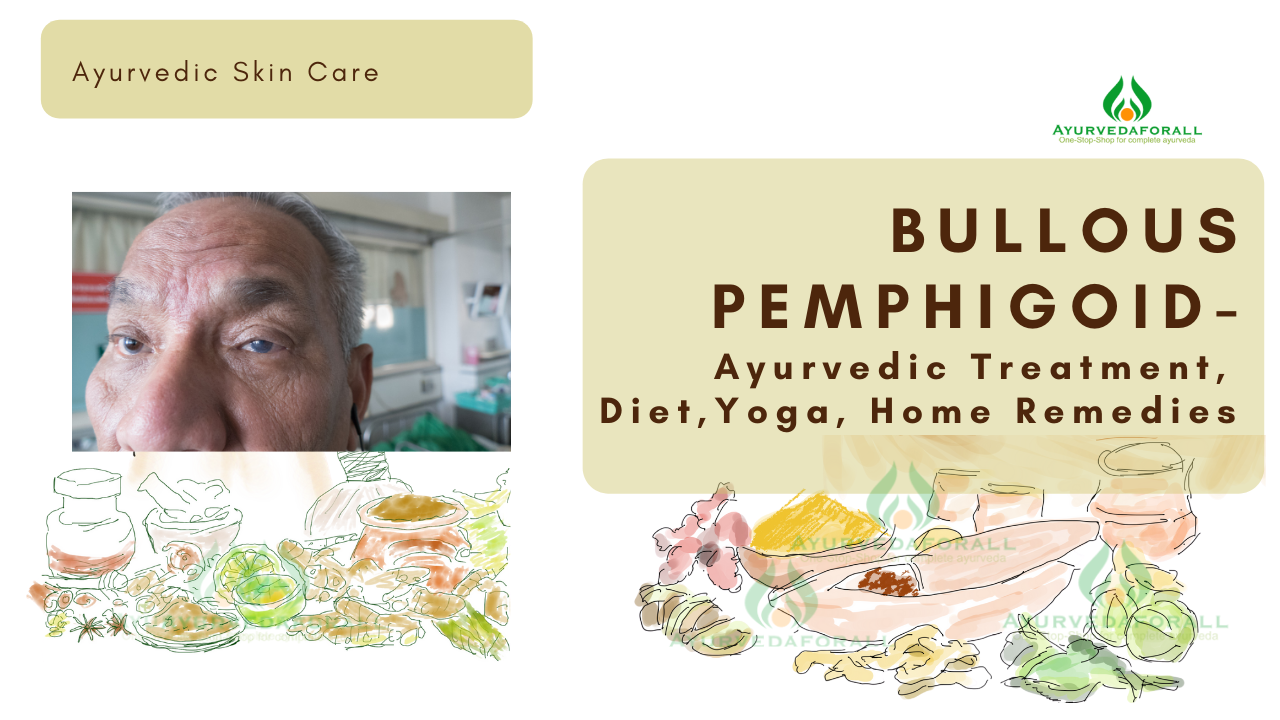
Bullous pemphigoid- Ayurvedic Treatment, Medicines, Diet, Exercises, Yoga, Research Papers


Bullous pemphigoid- Ayurvedic Treatment offers safe herbal management owing great results. Bullous pemphigoid is an autoimmune pruritic skin disease preferentially in older people that may involve the formation of blisters (bullae). Bullous pemphigoid occurs when your immune system attacks a thin layer of tissue below your outer layer of skin.

SIGNS AND SYMPTOMS of BULLOUS PEMPHIGOID

  • Itching skin lesions
  • The skin around the blisters that is normal or reddish
  • Eczema
  • The blisters are thick and don’t rupture easily
  • Blisters along creases or folds in the skin
  • Small blisters or sores in the mouth or other mucous membranes (benign mucous membrane pemphigoid)

CAUSES of BULLOUS PEMPHIGOID

  • Generally cause is unknown
  • People with other autoimmune disorders are found to be at a higher risk for developing pemphigoid.
  • Radiation therapy
  • Overuse of certain medications


PATHOPHYSIOLOGY of BULLOUS PEMPHIGOID

  • Pemphigoid is an autoimmune disease.
  • The immune system mistakenly begins to attack healthy tissues. In the case of pemphigoid, the immune system creates antibodies to attack the tissue just below the outer layer of skin.
  • This causes the layers of skin to separate and results in painful blistering.

DIAGNOSIS of BULLOUS PEMPHIGOID

  1. EXAMINATIONS of BULLOUS PEMPHIGOID


  • Inspection of the skin lesions


  1. INVESTIGATIONS of BULLOUS PEMPHIGOID


  • Laboratory tests – to detect the antibodies produced by the immune system


TREATMENTS of BULLOUS PEMPHIGOID

  • Corticosteroids, either in pill or topical form
  • Immunosuppressants
  • Anti-inflammatory medicines
  • Medicines for itching
  • Symptomatic treatments are more effective

 PROGNOSIS of BULLOUS PEMPHIGOID

Prognosis is generally incurable but the symptoms are manageable

COMPLICATIONS of BULLOUS PEMPHIGOID

  • Ruptured blisters are usually sensitive and painful
  • Permanent damage of skin tissue

BULLOUS PEMPHIGOID AND AYURVEDA

  • In Ayurveda, Bullous pemphigoid is fallen under visphota.
  • According to Ayurveda, twakrogas are known by the general term Kushta. Visphot is one of the types of Kshudra Kushta. Some of the symptoms of Visphot like shyav or raktavarni(Blackish or Red coloured), tanutwakyukta and stravyuktapitika (Bullae) are similar to Bullous pemphigoid.
  • General medicines used for the treatment of skin diseases (kushta) are effective in bullous pemphigoid.

 NIDANA- Ayurvedic CAUSES of BULLOUS PEMPHIGOID

  • Excess consumption of acrid, hot, ununctuous food
  • Injuries

PURVAROOPAM- Ayurvedic PREMONITORY SYMPTOMS of BULLOUS PEMPHIGOID

  • Reddish skin lesions

SAMPRAPTHI MATURATION of BULLOUS PEMPHIGOID

In the pathogenesis of Visphoṭaka, tridoṣas (vāta, pitta and kapha) are involved with the predominance of pitta and kapha.

LAKSHANA Ayurvedic SIGNS AND SYMPTOMS of BULLOUS PEMPHIGOID

  • Burning sensation
  • Fever
  • Thirst
  • Blisters on the skin
  • Sotha – inflammation
  • Kleda and srava – oozing

Ayurvedic PROGNOSIS of BULLOUS PEMPHIGOID

  • Difficult to cure – krichra sadhya

CHIKITSA- Ayurvedic TREATMENT of BULLOUS PEMPHIGOID

LOCAL

  • Local application of concentrated PañcavalkalaKvātha [decoction of the barks of five herbs, namely Ficus benghalensis (Vaṭa), Ficus glomerata Roxb. (Udumbara), Ficus religiosa Linn. (Aśvattha), Thespesia populnea Soland. ex Correa. (Pāriśa) and Ficus lecor Buch. Ham. (Plakṣa)]
  • Jatyadi taila

Ayurvedic SAMANA Treatment of BULLOUS PEMPHIGOID

  • Arogyavardhini Rasa
  • Gandhaka Rasāyana
  • Panchatikta ghrita

Ayurvedic SHODHANA/ Panchkarma Treatment of BULLOUS PEMPHIGOID

  • VIRECHANAM – mild purgation daily

COMMONLY USED Ayurvedic MEDICINES of BULLOUS PEMPHIGOID

Internal administration

HOME REMEDIES of BULLOUS PEMPHIGOID

  • Intake of Indian gooseberry – cools the body

DIET AND BEHAVIOUR for BULLOUS PEMPHIGOID

  • Avoid food items that produce dosha imbalance like cold and dry food, hard to digest. Because dosha imbalance aggravates the symptoms.
  • Consume easily digestible food items
  • Avoid exposure to sunlight

YOGA for BULLOUS PEMPHIGOID

  • Nadi Shuddi Pranayam – calms the mind and gets relief from the pain associated with blisters


The patient needs to be seated in a meditative posture with the head and spine erect, with the body relaxed. The patient has to close his one nostril (e.g. left nostril if using the right hand and vice versa) with the thumb and exhale completely through the other nostril. Again, he will have to breathe in deeply through the other nostril while the opposite nostril is still closed with the thumb.

RESEARCH PAPERS of BULLOUS PEMPHIGOID

  1. Autoimmune Bullous Skin Disease Managed with Ayurvedic Treatment: A Case Report

https://www.ncbi.nlm.nih.gov/pmc/articles/PMC5726192/#:~:text=Ayurveda%20is%20found%20to%20provide,medicines%20and%20achieved%20complete%20remission.

  1. Successful management of bullous pemphigoid (visphot) through ayurveda – a case study


http://ayurpub.com/wp-content/uploads/2016/08/502-506.pdf


Keywords: Bullous pemphigoid, visphota, Ayurveda

Bronchiectasis- Ayurveda Treatment, Medicines, Yoga, Diet, Precautions, Research Papers

Bronchiectasis

Bronchiectasis– Ayurveda Treatment is benefitting manyfold. Natural treatment for bronchiectasis uses herbs and minerals and is safe for long-term treatment. Bronchiectasis is a disease of the respiratory system. It is the destruction and widening of the large airways. If the disease is present at birth, it is called congenital bronchiectasis. If it is developed later in life, it is called acquired bronchiectasis.

Bronchiectasis Symptoms

  • Breathing difficulty
  • Wheezing
  • Breath odour
  • Chronic cough
  • Production of large amounts of foul-smelling sputum
  • Clubbing of fingers
  • Weight loss
  • Blood mixed sputum

Bronchiectasis Causes

  • Infection of airways
  • Inflammatory changes in the respiratory passage
  • Foreign bodies like food particles in the airway
  • Cystic fibrosis
  • Immunodeficiency syndrome

Bronchiectasis Pathophysiology

Due to the above-mentioned causes the bronchi are dilated, inflamed, and easily collapsible resulting in airflow obstruction and impaired clearance of secretions.

Bronchiectasis Diagnosis

EXAMINATIONS

Auscultation – when listening to the chest with a stethoscope, the doctor may hear clicking, bubbling, wheezing, rattling, or other sounds, usually in the lower lobes of the lungs.

INVESTIGATIONS

  • X – rays
  • Sputum culture
  • CT Scan – chest
  • Laboratory tests – to find out the underlying pathology

Bronchiectasis TREATMENTS

  • Antibiotics
  • Expectorants and Mucus-Thinning Medicines
  • Bronchodilators
  • Inhaled Corticosteroids
  • Oxygen Therapy
  • Surgery

PROGNOSIS

Prognosis is based on the cause of the disease, duration, and condition of the patient

COMPLICATIONS

  • Recurrent pneumonia
  • Empyema
  • Lung abscess
  • Recurrent pleurisy
  • Progressive respiratory failure
  • Cor pulmonale
  • Chronic bronchial infection
  • Pneumothorax
  • Life-threatening hemoptysis

BRONCHIECTASIS AND AYURVEDA

  • In Ayurveda, Bronchiectasis is considered a disease that occurs in the pranavaha srothas.
  • In charaka samhita chikitsa sthana, acharya mentioned five types of shwasa roga, among them bronchiectasis can be correlated to thamaka shwasa along with kaphaja kasa.
  • Ayurveda has several formulations to treat this condition and is in practice with proven efficiency.

NIDANA- Ayurvedic CAUSES

  • Exposure to dust and smoke
  • Residing in a cold place – seeta sthana
  • Use of cold water- seetambu sevana
  • Irregular meals
  • Injury to vital organs – marma ghata
  • Injury to chest – uro abhighata
  • Suppression of natural urges

PURVAROOPAM- Ayurvedic PREMONITORY SYMPTOMS

  • Pain in the chest
  • Aversion towards food
  • Restlessness
  • Pain in the flanks
  • Bad taste in the mouth

SAMPRAPTHI MATURATION

Due to the causative factors, pranavata combining with Kapha leaves its path and begins to move in the upward direction, giving rise to breathing difficulty, cough, etc.

TYPES OF SWASA

  • Ksudra swasa
  • Tamaka swasa
  • China swasa
  • Maha swasa
  • Urdwa swasa

TYPES OF KASA

  • Vata
  • Pitta
  • Kapha
  • Kshataja
  • Kshayaja

LAKSHANA- Ayurvedic SIGNS AND SYMPTOMS

  • Bronchiectasis can be called in ayurveda as tamaka swasa and kaphaja kasa
  • Wheezing sound – ghurghuraka
  • Breathing difficulty
  • The chest is full of sputum – vaksha sampoorna
  • Profuse expectorations
  • Viscid sputum

Ayurvedic PROGNOSIS of Bronchiectasis

  • Swasa roga is generally sadhya
  • Tamaka swasa is difficult to cure – krichra sadhya

CHIKITSA- Ayurvedic TREATMENT

  • Ayurvedic LOCAL of Bronchiectasis
  • Snehana using lavana taila and Svedam – local fermentation

Ayurvedic LOCAL of Bronchiectasis

Snehana using lavana taila and Svedam – local fermentation

Ayurvedic SAMANA treatment of Bronchiectasis

Ayurvedic SHODHANA and Panchkarma Treatment of Bronchiectasis

  • Dasamoola nirooha basthi is best in vata kapha roga chikitsa
  • Vamana
  • virechana

COMMONLY USED Ayurvedic MEDICINES for Bronchiectasis

Internal administration

Ayurvedic External Application for Bronchiectasis

  • Karpooradi taila application on chest region during breathing difficulty.

HOME REMEDIES for Bronchiectasis

  • Heat application on the chest area with a towel dipped in hot water
  • Steam inhalation

DIET AND BEHAVIOUR

  • Avoid food items that produce Kapha, Vata dosha imbalance like cold and dry food, hard to digest. Because Kapha, vata imbalance aggravates the symptoms.
  • Consume easily digestible food items
  • Avoid a heavy diet at bedtime.
  • Avoid drinking water immediately after food.
  • Avoid heavy exercises.

YOGA

Nadi Shuddi Pranayam – cleans the respiratory passage

The patient needs to be seated in a meditative posture with the head and spine erect, and the body relaxed. The patient has to close one nostril (e.g. left nostril if using the right hand and vice versa) with the thumb and exhale completely through the other nostril. Again, he will have to breathe in deeply through the other nostril while the opposite nostril is still closed with the thumb.


Bone Pain- Ayurvedic Treatment, Medicines, Diet, Yoga, Home Remedies

Bone Pain Ayurvedic Treatment

BONE PAIN

Ayurvedic treatment for Bone Pain is safe and effective. Bone pain is included under musculoskeletal diseases. In musculoskeletal diseases, pain is associated with bone, muscle, nerves, tendons, and ligaments. Bone pain is more intense than other aches.

SIGNS AND SYMPTOMS of Bone Pain

  • Pain varies from a dull constant ache to a sudden sharp feeling.
  • Bone pain also manifested in and around the joints.
  • Pain may radiate towards the muscles.
  • Pain aggravated during body movement.

CAUSES of Bone Pain

  • Mechanical
  • Inflammatory
  • Injuries
  • Cancer and metastasis
  • Osteoporosis
  • Osteomyelitis
  • Fractures
  • Degenerative diseases
  • Mineral deficiency
  • Leukaemia
  • Deficiency of vitamin D
  • Infections

PATHOPHYSIOLOGY  of Bone Pain

  • Stimulation of specialized pain-sensitive nerve fibres (nociceptors) that innervate bone tissue leads to the sensation of bone pain.
  • Bone pain originates from both the periosteum and the bone marrow which relay nociceptivesignals to the brain creating the sensation of pain. Bone tissue is innervated by both myelinated (A beta and A delta fiber) and unmyelinated (C fibre) sensory neurons.
  • In combination, they can provide an initial burst of pain, initiated by the faster-myelinated fibres, followed by a slower and longer-lasting dull pain initiated by unmyelinated fibres.
  • Nociceptors responsible for bone pain can be activated via several mechanisms including deterioration of surrounding tissue, bone destruction and physical stress which shears the bone, vascular, muscle, and nervous tissue.

DIAGNOSIS of Bone Pain

  1. EXAMINATIONS of Bone Pain
  • Inspection
  • Palpation
  • Movements – Flexion, Extension, forward bending, Lateral bending (in the case of joints)
  1. INVESTIGATIONS of Bone Pain
  • X – rays
  • MRI
  • CT Scan
  • Laboratory tests – to find out the underlying pathology

TREATMENTS of Bone Pain

  • Physiotherapy and pain relievers can help. A few cases may require surgery.
  • Medications – Non-steroidal anti-inflammatory drug, Analgesic and Narcotic.
  • In the case of nutrient deficiency, calcium and vitamin D supply.
  • Radiotherapy


PROGNOSIS of Bone Pain

  • Prognosis is based on the cause of the bone pain, duration and condition of the patient

COMPLICATIONS of Bone Pain

  • Permanent damage of bone tissue
  • Unable to do any movement
  • Metastasis may spread to other areas


BONE PAIN AND AYURVEDA

  • In Ayurveda, bone pain falls under Vatavyadhi or a Vata dosha imbalance disorder.
  • Vata dosha and asthi dhatu are involved.
  • Vata vyadhi can be correlated to neurological or neuromuscular disorders. The causes and pathogenesis of diseases caused by vitiation of Vata dosha, in general, are the exclusive cause and pathogenesis ofbone pain.
  • Bone diseases in Ayurveda coming under the heading asthi roga.


NIDANA- Ayurvedic CAUSES of Bone Pain

  • Excess consumption of unctuous, cold food
  • Excessive physical exercise.
  • Suppression of natural urges.
  • Trauma
  • Injuries
  • Bhagna – bone fracture
  • Asthi vidradhi – abscesses of bone and bone marrow
  • Asthi dhatu kashaya


PURVAROOPAM- Ayurvedic PREMONITORY SYMPTOMS of Bone Pain

  • Dull intermittent pain in the bones and joints on movement.


SAMPRAPTHI – MATURATION of Bone Pain

  • Vata, pitta and kapha dosha move through all channels of circulation. Due to the subtle nature of vata it impels the remaining two doshas.
  • The aggravated vata having provoked these two doshas, exacerbated and fills up the empty channels and moves greatly inside them or by getting enveloped by the other doshas.
  • The aggravated vata resides in the bones and joints and produces different kinds of aches and pains.

LAKSHANA Ayurvedic SIGNS AND SYMPTOMS of Bone Pain

  • Asthi toda – Dull ache to sharp pricking pain
  • Stiffness of joints
  • Unable to bend forward when it associated with the spine.
  • Pain aggravates on movement

Ayurvedic PROGNOSIS of Bone Pain

  • Bone pain associated with traumatic injuries is difficult to cure – krichra sadhya

CHIKITSA- Ayurvedic TREATMENT for Bone Pain

LOCAL Ayurvedic Treatment for Bone Pain

  • Svedam – local fomentation
  • Pain-relieving lepa application

SAMANA Ayurvedic Treatment for Bone Pain

 SHODHANA

  • VASTHI- Erandamooladi yapana vasthi
  • SNEHAVIRECHANAM-Eranda tailam
  • NASYA-Ksheerabala

COMMONLY USED MEDICINES

Internal administration

External Application

Also Consider:

HOME REMEDIES

  • Heat application on the affected area by a towel dipped with hot water
  • Massage the painful area for 15 minutes ( NOT too much pressure )
  • Fomentation with water boiled with herbs like Moringa, Nirgundi, Sahachara, etc.

DIET AND BEHAVIOUR

  • Avoid food items which produce vata dosha imbalance like cold and dry food, hard to digest. Because vata imbalance aggravates the symptoms.
  • Consume easily digestible food items, cow’s milk
  • Avoid heavy exercises which further aggravate the conditions.
  • Oil massage on body advised. Which alleviates vata dosha
  • Take proper rest in the case of fracture.


YOGA

  • Nadi Shuddi Pranayam – calms the mind and gets relief from aches and pains


The patient needs to be seated in a meditative posture with the head and spine erect, with the body relaxed. The patient has to close his one nostril (e.g. left nostril if using the right hand and vice versa) with the thumb and exhale completely through the other nostril. Again, he will have to breathe in deeply through the other nostril while the opposite nostril is still closed with the thumb.

RESEARCH PAPERS

  1. Ayurveda in Treatment of Bone Disorders in Human: A Review

https://www.researchgate.net/publication/270612897_Ayurveda_in_Treatment_of_Bone_Disorders_in_Human_A_Review

  1. Avascular necrosis of Femoral head post corticosteroid therapy: A Case Study

https://core.ac.uk/download/pdf/266975243.pdf


Keywords: Bone pain, asthi roga, Ayurveda

RASAGANDHI MEZHUGU- Benefits, Ingredients, Indications, Dosage, Usage, Diet, Exercises, Contraindications, Equivalent Medicines, Research Papers

Rasagandhi Mezhugu is a classical Siddha medicine used in the management of a broad spectrum of diseases. This medicine is available in the form of a capsule. This capsule contains mineral ingredients along with herbs. This medicine should only take as per the direction of the physician.

Rasagandhi Mezhugu Capsules benefits

  •  This medicine can be administered mainly in diseases with vata dosha imbalance.
  • Vata dosha responsible for various kinds of pain
  • . This medicine promotes strength to bones and joints, therefore it can be given for musculoskeletal disorders
  • Its analgesic action is effective in muscle spasms, joint pain, and backache.
  • Its anti-inflammatory action is effective in inflammatory joint diseases and bursitis.
  • This medicine is also effective in skin diseases such as itches, rashes, leprosy, and scabies.

Rasagandhi mezhugu

INDICATIONS

Kaal kudaichal     :	Leg Pain
Vippurudhi             :	Fissures
Thozhu noi	            :Leprosy
Sori	                            :Itches
Sirangu	                   :Scabies
Puzhuvettu	          :Alopecia
Thadippu                :	Rashes
Glandular Enlargements
Seng Granthi	- Swollen Glands
Karung Grandhi	- Swollen Throat Glands
Ari Grandhi	- Swollen Lymph Glands
Pori Grandhi	- Swollen Abscess Glands
Padu Grandhi	- Swollen Testicular Glands
Malignant Lesions
Kanna Puttru	- Ear Tumor
Aankuri Puttru	- Skin Tumor
Penkuri Puttru	- Breast Tumor
Moolam	Piles
Pouthiram	Fistula

INGREDIENTS OF RASAGANDHI MEZHUGU

 SL NO	CLASSICAL NAME	ENGLISH	LATIN	QUANTITY	ACTION
1	Rasam	Purified mercury 4.16 gm	Fast relief from symptoms
2	Gandhakam	Purified sulphur 4.16 gm	Effective in skin diseases
3	Rasa karpooram	Mercurous chloride 4.16 gm	Effective in skin diseases
4	Talakam	Arsenic trisulphide 4.16 gm	Effective in respiratory diseases
5	Kantha loha	magnetite 4.16 gm	tonic and rejuvenator
6	thurishu	Copper sulphate 4.16 gm	Relieves pain
7	Pal thutham	Zinc carbonate 4.16 gm	Effective in diabetes
8	Mridharasringi	Lead monoxide 4.16 gm	Provide general health
9	chukku	ginger	Zingiber officinale	4.16 gm	carminative
10	omam	Carom seed	Trachyspermum ammi	4.16 gm	carminative
11	manjal	turmeric	Curcuma longa	4.16 gm	Anti inflammatory, anti bacterial
12	vidangam Embelia ribes	4.16 gm	Effective in worm infestation
13	vasambu Acorus calamus	4.16 gm	Balances kapha and vata
14	lavangam	Clove	Syzygium aromaticum	4.16 gm	analgesic effect
15	Parangi pattai Smilax china	4.16 gm	Effective in malignancy,syphilis
16	Seran kottai	Marking nut	Semicarpus anacardium	4.16 gm	Rejuvenation
17	katukkai	Chebulic myrobalan	Terminalia chebula	4.16 gm	rejuvenation
18	Karun seerakam	Black caraway	Nigella sativa	4.16 gm	carminative
19	Kattu seerakam Centratherum anthelminticum	4.16 gm	Useful in worm infestation,general debility
20	sirutheku Premna herbaceae	4.16 gm
21	Thaleesa patra Taxus baccata	4.16 gm	Effective in respiratory diseases
22	Thiraatchi Vitis vinifera	4.16 gm	General tonic
23	thippali	Long pepper	Piper longum	4.16 gm	carminative
24	sitrarathai Alpinia spinosa	4.16 gm	Balances vata
25	kottam Saussurea lappa	4.16 gm	Effective in skin diseases
26	Valuluvai arisi Celastrus paniculatus	4.16 gm
27	Perum seerakam	Fennel seed	Foenicum vulgare	4.16 gm	carminative
28	ela	cardamom	Elettaria cardomomum	4.16 gm
29	jathikkai	nutmeg	Myristica fragrans	4.16 gm	balances vata dosha, action on central nervous system
30	milaku	Black pepper	Piper nigrum	4.16 gm	Effective in indigestion
31	seerakam	Cumin seed	Cuminum cyminum	4.16 gm	carminative
32	Karboga arisi Psoralea corylifolia	4.16 gm	Effective in skin diseases
33	maasikkai Quercus infectoria	4.16 gm	Effective in wound, piles,bleeding
34	Thippali mulam	Long pepper root	Piper longum	4.16 gm	Useful in asthma, indigestion
35	Pirappan kizhangu Calamus rotang	4.16 gm
36	ettikottai Strychnos nux vomica	4.16 gm	balances kapha and vata
37	thetraankottai Strychnos potatorum	4.16 gm	Effective in skin diseases
38	Neermulli vidhai Asteracantha longifolia	4.16 gm
39	yellu	Sesame seed	Sesamum indicum	4.16 gm	Balances vata
40	Kopparai thengai	coconut	Cocos nucifera	4.16 gm
41	kollu	barley	Hordeum vulgare	4.16 gm	Provide energy
42	Siru chinni ver Acalypha fruiticosa	4.16 gm
43	Mutchangan ver Azima tetracantha	4.16 gm
44	Amukkura kizhzngu Withania somnifera	4.16 gm	Beneficial effect in central nervous system
45	Aakasa garudan kizhzngu corallocarpusepigaeus	4.16 gm
46	Kodiveli ver Plumbago zeylanica	4.16 gm	carminative
47	Kozhi muttai	egg Quantity sufficient	Protein rich

METHOD OF PREPARATION

Prepare a syrup with 200 gms of palm jaggery (weight equivalent to the weight of all other ingredients added together). Add all powders (4.16 gm each) to the syrup and pound for 12 hrs to get a uniform waxy mass.

  1. Detoxification of Parada – Ground with the juice of Aloevera, Triphala (Terminalia chebula, Terminalia bellerica, Emblica officinalis), root of chitraka (Plumbago zeylanica) each for 7 days.
  2. Detoxification of Gandhaka – fried in ghee and dipped in cow’s milk repeated 7 times.

DOSHA- DUSHYA PREDOMINANCE AND ROGA MARGA

  •  Dosha – This medicine is recommended for the treatment of all vata-predominant diseases.
  • vata dosha is responsible for the manifestation of various kinds of pain in the body.
  • Dushya- useful in diseases affecting rasa, raktha, mamsa ,asthi ,majja dhatu –musculoskeletal diseases, skin diseases.
  • Roga marga – This medicine can be administered for diseases affecting all roga marga
  • Bahya roga marga – skin diseases, piles, wounds
  • Abhyanthara roga marga – respiratory diseases
  • Madhyama roga marga –joint pain, muscle pain

RASAGANDHI MEZHUGU Dosage

  • 1 to 2 capsules with palm jaggery twice daily after taking rice with buttermilk or as directed by a physician.

EXERCISES AND YOGA

Yoga and Pranayama are a set of breathing and stretching exercises respectively, widely practiced in the treatment of many diseases.

Nadi Shuddi Pranayam   – for getting calmness to the mind provide overall health.

The patient needs to be seated in a meditative posture with the head and spine erect, and the body relaxed. The patient has to close one nostril (e.g. left nostril if using the right hand and vice versa) with the thumb and exhale completely through the other nostril. Again, he will have to breathe in deeply through the other nostril while the opposite nostril is still closed with the thumb.

   RECOMMENDED DIET AND BEHAVIOUR

  •  Avoid food items that produce dosha imbalance like cold, more salt, sour and dry food, hard to digest.
  • Because dosha imbalance aggravates the symptoms.
  • Consume easily digestible food items Avoid heavy exercises that further aggravate degenerated conditions.
  • Oil massage on the body is advised. Which alleviates vata dosha and reduces body pain.
  • Avoid smoking and alcohol

RASAGANDHI MEZHUGU Capsules Side Effects

  •  This medicine should only take as per the direction of the physician.
  • It is better to avoid children, and lactating women, and during pregnancy.
  • Improper administration and overdosage lead to side effects.

Frequently Asked Questions

  1.  Can RASAGANDHI MEZHUGU be used while taking Allopathic medicines?

Seek your doctor’s advice if you are taking this medicine along with Allopathic medicines.

  1. How long RASAGANDHI MEZHUGUcan be used?

The duration of medicinal administration is based on the stage of the disease. Before taking medicine consult a physician.

CLASSICAL REFERENCE

Pulipani Vaidyam – 500

EQUIVALENT MEDICINES

Mahayoga raja guggulu Kanchanara guggulu

 AVAILABLE BRANDS

  1. SKM Siddha And Ayurveda Company India Ltd.
  2. Jaya Indian Medicine Pharmaceutical (P) Ltd

You can now find rasagandhi mezhugu online making it easier for individuals to access this ayurvedic product.