
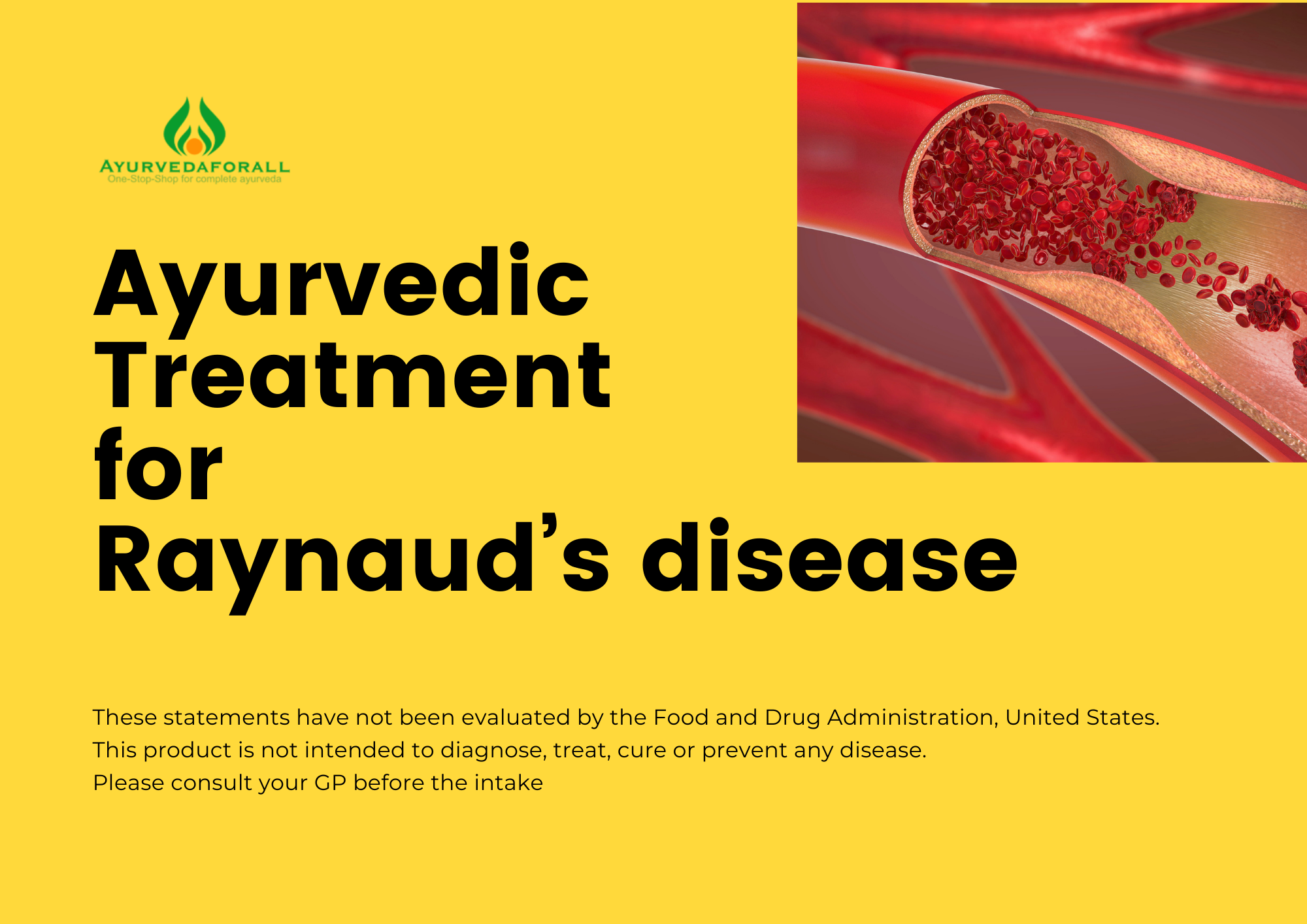
Ayurvedic Treatment for Raynaud’s disease is based on the Vatarakta Chikitsa principle. Raynaud’s is an uncommon vascular disorder that affects the arteries. Arteries are blood vessels that carry blood from the heart to different parts of the body. In Raynaud’s disease, smaller arteries that supply blood to the skin become narrow, limiting blood flow to affected areas (vasospasm). Women are affected more than men. It is more common in people who live in colder climates. The disorder is marked by brief episodes of vasospasm or narrowing of small blood vessels or capillaries. Vasospasm of the arteries causes decreased blood flow to the fingers and toes. Raynaud’s disease causes some areas of the body, such as the fingers and toes — to feel numb and cold in response to cold temperatures or stress.
Signs and symptoms
The arteries become very narrow for a brief period. As a result, blood flow is restricted or stopped to the affected body parts. This may cause these areas to:
- Turn pale or white and then blue
- Feel numb, cold, or painful
- Turn red, throb, tingle, burn, or feel numb as blood flow returns to the affected areas
Numbness and prickly feeling upon pressing or warming the area. Mostly it takes around 15 minutes or more time to restore the normalcy of blood circulation.
Causes
Two types of Raynaud’s disease are primary and secondary.
When the cause is not known, it is primary.
Secondary Raynaud’s is caused by an underlying disease or other factors such as:
- Diseases and conditions directly damage the arteries or damage the nerves that control the arteries in the hands and feet.
- Repetitive actions that damage the nerves that control the arteries in the hands and feet
- Injuries to the hands and feet
- Exposure to certain chemicals
- Medicines that narrow the arteries or affect blood pressure
- Certain medicines including beta-blockers for high blood pressure, migraine medications that contain ergotamine and sumatriptan, attention-deficit/hyperactivity disorder medications, and some chemotherapy agents.
Physiopathologie
Vascular tone is controlled by complex interactions between factors like endothelial cells, the muscular layer, soluble mediators and neuronal stimulation. The imbalance between strong vasoconstriction and weaker vasodilatation is the main key factor here. Some of the underlying pathological mechanisms may be intrinsic disturbances of endothelial or vascular smooth muscle cells; some may be extrinsic, encompassing neuro-regulation and soluble mediators.
Diagnostic
- Clinical examination
- Cold stimulation test
- Nailfold capillaroscopy
- Antinuclear antibodies test
- Erythrocyte sedimentation rate.
Traitements
Treatments include lifestyle changes like avoiding cold temperatures.
Dressing for the cold in layers and wearing gloves or heavy socks will help in mild cases.
medicines like calcium channel blockers, alpha-blockers, prescription skin creams, and ACE inhibitors, and vasodilators. In rare cases, surgery to block the nerves in the hands or feet that control the arteries and Botox injection are needed.
Pronostic
Raynaud’s disease has no permanent cure. Treatments can be helpful to decrease the number and severity of Raynaud’s attacks.
Complications
If secondary Raynaud’s is severe, in rare cases, reduced blood flow to the fingers or toes can cause tissue damage. It can end up in skin sores or gangrene.
Ayurvedic Concept of Raynaud’s Disease
According to Ayurveda, movement is the function of Vaata dosha. When Vaata vitiates in the bold vessels it is called Siraagata Vaata.
Ayurvedic Nidana of Raynaud’s Disease
Dhaatukshaya (degeneration of body tissues)
Aavarana (obstruction in the channels)
Ayurvedic Purvaaroopa of Raynaud’s Disease
Non mentionné
Ayurvedic Samprapti of Raynaud’s Disease
Due to the causative factors, Vaata dosha is vitiated and gets lodged in the blood vessels and cause the disease.
Ayurvedic Lakshana of Raynaud’s Disease
Aadhmaana and riktata of siras – alternate distension and emptying of blood vessels
Ayurvedic Divisions of Raynaud’s Disease
Non mentionné
Ayurvedic Prognosis of Raynaud’s Disease
Yaapya
Ayurvédique Chikithsa of Raynaud’s Disease
Treatment of siraagatavaata includes local and whole-body treatments. Bringing back the vitiated Vaata into its normal ciurse is the main target. T includes snehana or oleation(when aama is not present), daahakarma(local cauterization with heat) and upanahanam (bandage )
Samana
Snehanam
Upanaaham
Sodhana
Daahakarmam
Then treatment of wound should be done
Commonly used Ayurvedic medicines for Raynaud’s Disease
Amruthotharam kashayam
Balaguduchyadi kashayam
Kaisoraguggulu
Guduchisatwa
Marques disponibles
AVS Kottakal
AVP Coimbatore
SNA oushadhasala
Vaidyaratnam oushadhasala
Home remedies for Raynaud’s Disease
Preventive measures for episodes of Raynaud’s attacks:
- Bundle up outdoors.Use a hat, scarf, socks and boots, and two layers of mittens or gloves before going out in the winter.
Use chemical hand warmers.
- Warm the car.Run the car heater for a few minutes before driving in cold weather.
Set the air conditioner to a warmer temperature. Use insulated drinking glasses.
Diet for Raynaud’s Disease
- À éviter
Les repas lourds et les aliments difficiles à digérer provoquent des indigestions.
Junk foods- cause disturbance in digestion and reduces the bioavailability of the medicine
Boissons gazeuses - rendent l'estomac plus acide et perturbent la digestion
Aliments réfrigérés et congelés - provoquent une digestion faible et paresseuse en affaiblissant Agni (le feu digestif).
Milk and milk products – increase kapha, cause obstruction in channels and obesity
Caillé - provoque le vidaaha et, par conséquent, de nombreuses autres maladies
- A ajouter
Des repas légers et des aliments faciles à digérer
Green gram, soups, sesame oil
Aliments fraîchement cuits et chauds traités avec des graines de cumin, du gingembre, du poivre noir, de l'ajwain, etc.
Comportement :
Protect yourself from cold climate.
Il est préférable d'éviter une exposition excessive à la lumière du soleil, au vent, à la pluie ou à la poussière.
Maintenir une alimentation et un sommeil réguliers.
Évitez de retenir ou de forcer les envies comme l'urine, les selles, la toux, les éternuements, etc.
Avoid a sedentary lifestyle. Be active
Yoga for Raynaud’s Disease
Regular stretching and mild cardio exercises are advised. Also, specific yogacharya including naadisuddhi pranayama, bhujangaasana, pavanamuktasana is recommended.
Regular exercise helps improve the bioavailability of the medicine and food ingested and leads to positive health.
Le yoga permet de maintenir l'harmonie à l'intérieur du corps et avec le système environnant.
Pavanamuktasana
Nadisudhi pranayama
Bhujangasana
Exercices simples pour la santé des poumons et du cœur
Tous les exercices et les efforts physiques doivent être décidés et effectués uniquement sous la supervision d'un expert médical.
Research articles of Raynaud’s Disease
https://www.ncbi.nlm.nih.gov/pmc/articles/PMC6139949/
doi: 10.1191/1358863x02vm455oa.
A clinical study was done to investigate the clinical efficacy of a standardized Ginkgo biloba extract (Seredrin) in the treatment of Raynaud’s phenomenon in patients with no apparent, associated condition such as systemic sclerosis. There was a significant effect in the number of attacks per day in the treatment group over placebo.
https://doi.org/10.1161/CIRCULATIONAHA.104.523324
To investigate the effects of sildenafil on symptoms and capillary perfusion in patients with Raynaud’s phenomenon, a double-blinded, placebo-controlled, fixed-dose, crossover study was done in 16 patients with symptomatic secondary Raynaud’s phenomenon resistant to vasodilatory therapy. Patients were treated with 50 mg sildenafil or placebo twice daily for 4 weeks.
Sildenafil is an effective and well-tolerated treatment in patients with Raynaud’s phenomenon.
*These statements have not been evaluated by the Food and Drug Administration, United States. This product is not intended to diagnose, treat, cure or prevent any disease. Please consult your GP before the intake. All the Ayurveda Supplements mentioned here are in the Indian Market with GMP Certification from India

Rédacteur :
Rajesh Nair, cofondateur et consultant en chef d'Ayurvedaforall.Com, est diplômé du prestigieux Vaidyaratnam Ayurveda College (affilié à l'université de Calicut), au Kerala, en Inde. Il est également titulaire d'un diplôme de troisième cycle en thérapie par le yoga de l'université d'Annamalai.
Le docteur Nair propose des consultations dans deux cliniques très fréquentées à Haripad, Alleppey, Kerala, l'État du sud, célèbre dans le monde entier pour ses traitements ayurvédiques authentiques et ses médecins. Tout en offrant des consultations sur tous les aspects des traitements ayurvédiques, le Dr Nair s'intéresse tout particulièrement au Panchkarma, au yoga et aux massages.
Grâce à Ayurvedaforall, le Dr Nair propose des consultations en ligne à des patients du monde entier et a servi des centaines de patients au cours des 20 dernières années. En plus de sa pratique ayurvédique, il est le rédacteur en chef de ayurveda-amai.org, le portail en ligne de l'Ayurveda Medical Association of India, et le membre du comité d'État de l'Ayurveda Medical Association of India.
Le Dr Nair participe régulièrement à des conférences sur l'Ayurvéda et s'est rendu en Allemagne pour propager l'Ayurvéda. Vous pouvez lui écrire directement
rajesh@ayurvedaforall.com
Whatsapp - +91 9446918019, +91 8075810816
URLs : https://www.ayurvedaforall.com/
https://www.ayurvedaforall.co.uk/
Pour vous donner une idée rapide d'Ayurvedaforall, nous sommes un groupe de praticiens ayurvédiques engagés à propager l'Ayurveda dans sa meilleure tradition à travers le monde. Notre boutique en ligne vend des formules ayurvédiques authentiques accompagnées de conseils professionnels. Le site, qui en est à sa dix-septième année d'existence, nous a permis de nous constituer une clientèle dévouée qui utilise régulièrement nos produits et nos services et qui nous recommande d'autres personnes. Il va sans dire que nous y sommes parvenus grâce à notre adhésion aux normes les plus élevées en matière de service à la clientèle et d'éthique professionnelle.
 Français
  English
  Русский
  Deutsch
  Türkçe
  Italiano
  Español