

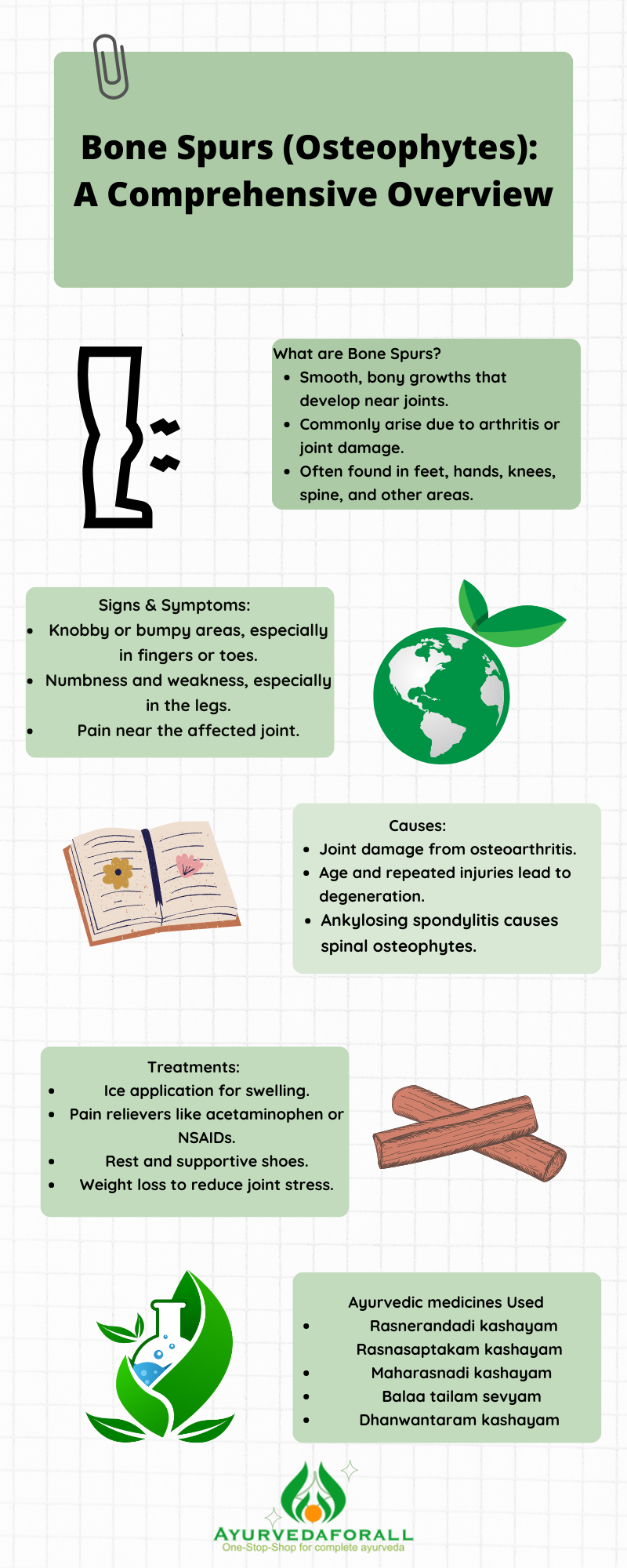
Bone spurs, or Osteophytes, are smooth, bony growths, usually near joints. They develop over time in patients with arthritis or joint damage. The feet, hands, knees and spine often develop bone spurs. A healthy lifestyle can delay symptoms like pain, stiffness, and limited motion. Medications, physical therapy, and surgery may help. In most cases, it is a smooth, bony lump that grows off a bone. Bone spurs are most common in people 60 years or older, but younger people can get them, too. People with osteoarthritis are much more likely to get bone spurs. Osteoarthritis is a common form of “wear and tear” arthritis that happens when cartilage, which cushions your bones, wears down.
Although they can grow from any bone, osteophytes are particularly common in the:
- Foot, especially the heel (heel spurs or calcaneal spurs), big toe and ankle.
- Hand or finger.
- Hip
- Knee
- Neck
- Shoulder
- Spine
Entdecken Sie: Zeoton Softgels for Osteoarthritis Relief
Signs & Symptoms
Some people have bone spurs and don’t even know it. Spurs start to create symptoms when they:
- Put pressure on nearby nerves.
- Restrict movement.
- Rub against other bones or tissues.
When that happens, the person may notice:
- Knobby or bumpy areas, especially in the fingers or toes.
- Numbness and weakness, especially in the legs if the spine has spurs.
- Pain near the affected joint, like heel pain.
- Reduced movements of joints.
- Stiffness.
- Tendinitis (swelling of a nearby tendon).
- Tendon tears (like a rotator cuff tear in the shoulder).
Verursacht
- Joint damage from osteoarthritis is the biggest cause of bone spurs. Age and repeated injury can be a reason for degeneration and osteoarthritis. As the body tries to repair cartilage, it creates new bone material. These new bony growths are osteophytes.
- Ankylosing spondylitis is another main cause. The body responds to the inflammation by forming spinal osteophytes.
Entdecken Sie: Nucart OA Tablet for osteoarthritis relief
Pathophysiologie
Primary and secondary osteoarthritis are not separable on a pathologic basis, though bilateral symmetry is often seen in cases of primary osteoarthritis, particularly when the hands are affected Traditionally, osteoarthritis was thought to affect primarily the articular cartilage of synovial joints; however, pathophysiologic changes are also known to occur in the synovial fluid, as well as in the underlying (subchondral) bone, the overlying joint capsule, and other joint tissues.
Although osteoarthritis has been classified as noninflammatory arthritis, increasing evidence has shown that inflammation occurs as cytokines and metalloproteinases are released into the joint. These agents are involved in the excessive matrix degradation that characterizes cartilage degeneration in osteoarthritis. Therefore, it is no longer appropriate to use the term degenerative joint disease when referring to osteoarthritis.
Studies of interleukin-17 (IL-17), a proinflammatory cytokine, have found increased IL-17 levels in the synovium of osteoarthritis joints, as is seen in inflammatory arthritis (ie, rheumatoid arthritis). Other inflammatory molecules that have been associated with osteoarthritis include 15‐hydroxyeicosatetraenoic acid, prostaglandin E2, IL‐1β, TNF alpha, IL‐1 receptor antagonist, and uric acid.
In early osteoarthritis, swelling of the cartilage usually occurs, because of the increased synthesis of proteoglycans; this reflects an effort by the chondrocytes to repair cartilage damage. However, proinflammatory cytokines result in deterioration of chondrocyte metabolism. This stage may last for years or decades and is characterized by hypertrophic repair of the articular cartilage.
As osteoarthritis progresses, however, the level of proteoglycans eventually drops very low, causing the cartilage to soften and lose elasticity and thereby further compromising joint surface integrity. Microscopically, flaking and fibrillations (vertical clefts) develop along the normally smooth articular cartilage on the surface of an osteoarthritic joint. Over time, the loss of cartilage results in loss of joint space.
In major weight-bearing joints of persons with osteoarthritis, a greater loss of joint space occurs in those areas experiencing the highest loads. This effect contrasts with that of inflammatory arthritides, in which uniform joint-space narrowing is the rule.
In the osteoarthritic knee, for example, the greatest loss of joint space is commonly seen in the medial femorotibial compartment, though the lateral femorotibial compartment and patellofemoral compartment may also be affected. Collapse of the medial or lateral compartments may result in varus or valgus deformities, respectively.
Studies showed that the serum uric acid level can predict future joint space narrowing.
Erosion of the damaged cartilage in an osteoarthritic joint progresses until the underlying bone is exposed. Bone denuded of its protective cartilage continues to articulate with the opposing surface. Eventually, the increasing stresses exceed the biomechanical yield strength of the bone. The subchondral bone responds with vascular invasion and increased cellularity, becoming thickened and dense (a process known as eburnation) at areas of pressure.
The traumatized subchondral bone may also undergo cystic degeneration, which is attributable either to osseous necrosis secondary to chronic impaction or to the intrusion of synovial fluid. Osteoarthritic cysts are also referred to as subchondral cysts, pseudocysts, or geodes and may range from 2 to 20 mm in diameter. Osteoarthritic cysts in the acetabulum are termed Egger cysts.
Anteroposterior (AP) radiograph of the hip reveals severe superior migration of the femoral head (which reflects loss of articular cartilage), subchondral sclerosis, prominent osteophytes, and a large Egger cyst in the superior acetabulum. Mild flattening of the superior aspect of the femoral head is present.
At areas along the articular margin, vascularization of subchondral marrow, osseous metaplasia of synovial connective tissue, and ossifying cartilaginous protrusions lead to irregular outgrowth of new bone (osteophytes). Fragmentation of these osteophytes or of the articular cartilage itself results in the presence of intra-articular loose bodies (joint mice).
Along with joint damage, osteoarthritis may also lead to pathophysiologic changes in associated ligaments and the neuromuscular apparatus. For example, lateral collateral ligament complex abnormalities are common in knee osteoarthritis.
Diagnose
- Xray
- CT scan
- MRI
Behandlungen
- No treatment is needed if the bone spur does not cause any discomfort.
Some measures to help ease osteophyte symptoms:
- Ice to reduce swelling.
- Over-the-counter pain relievers, such as acetaminophen or NSAID s like ibuprofen.
- Rest.
- Supportive shoes or shoe inserts.
- Weight loss to decrease joint and bone stress.
In more severe and serious cases,
Physical therapy: Exercises and stretches can reduce pain, improve range of motion and strengthen muscles around joints.
Prescription pain medications: If over-the-counter pain medicines don’t provide relief, a stronger analgesic or cortisone injection will be needed.
Surgery: If symptoms continue after a year of treatment, surgery can remove the bone spurs.
Prognose
Osteophytes have a long-term pathology with a bad prognosis. In most of the cases, bone spurs don’t go away without surgical removal.
Komplikationen
- Arthritis is mostly a severe form of osteoarthritis
- Severe pain & swelling
- Restriction of movements
- Joint deformities and postural changes
Krankheit & Ayurveda
Asthidhatu (Bone tissue) in Ayurveda is structurally & functionally inversely proportional to the amount of Vaatadosha. When Vaata is excess due to age or other degenerative conditions, asthidhatukshaya or depletion can take place. This can be understood as osteoporosis and degenerative osteoarthritis. But in some other cases, excess asthidhatu means extra bone growth. Though it seems like bone spurs are extra bone growth, the condition is actually depletion of bone tissue or asthidhatukshaya.
Nidana
- Causative factors for degeneration like old age, poor nourishment etc which leads to Vaatakopa
- Kshata (injury)
Purvaaroopa
Nicht erwähnt
Samprapti When the vitiated doshas, which mainly affects asthidhatu along with dhatvagni (metabolic digestive fire) are vitiated the formation of asthidhatu gets abnormal and produces disease.
Lakshana Sandhisaidhillya – looseness of joints Shrama – fatigue Prapatana of kesa, loma, nakha etc. – Hairfall, brittle nails and teeth etc. Divisions Not mentioned
Prognose
- Saadhya in new cases in young people.
Yaapya in chronic cases and old people
Chikithsa
Ayurveda treatment for dhatukshaya starts with aamapaachana(removal of accumulated toxic waste products in the system). Once the aama is removed, medicines are given to enhance and normalize agni (digestive fire). Normal and stable digestive fire means proper digestion, absorption, and assimilation. When the asthidhatu is properly nourished, the depletion is cured. According to Ayurveda, asthidhatu is formed from medodhatu(fat tissue). So proper functioning of medodhatu and intake of medicated oils and ghee in proper conditions will be beneficial.
Samana
Aamappaachana
Agnideepana
Lepana and pradesika dhara with soolaharadravya
Pichu
Upanaha
Sodhana
Sneha-sweda
Kshayavasti
Snehavvasti
Virechana
Häufig verwendete Arzneimittel
- Rasnerandadi kashayam
- Rasnasaptakam kashayam
- Maharasnadi kashayam
- Balaa tailam sevyam
- Dhanwantaram kashayam
- Dhanwantaram tailam
- Yogaraja guggulu
- Gulguluthiktakam Ghrutham
Verfügbare Marken
- AVS Kottakal
- AVP Coimbatore
- SNA oushadhasala
- Vaidyaratnam oushadhasala
Hausmittel
There are no home remedies o cure bone spurs. But a healthy diet and lifestyle will help in preventing the chance of developing bone spurs.
Diät
Zu vermeiden sind
- Schwere Mahlzeiten und schwer verdauliche Lebensmittel - verursachen Verdauungsstörungen.
- Junk Food - stört die Verdauung und verringert die Bioverfügbarkeit des Medikaments
- Kohlensäurehaltige Getränke - erhöhen den Säuregehalt des Magens und stören die Verdauung
- Gekühlte und gefrorene Lebensmittel - verursachen eine schwache und träge Verdauung durch Schwächung von Agni (Verdauungsfeuer)
- Milch und Milchprodukte - erhöhen Kapha, verursachen Verstopfung in den Kanälen und Fettleibigkeit
- Quark - verursacht Vidaaha und damit viele andere Krankheiten
Noch zu ergänzen
- Leichte Mahlzeiten und leicht verdauliche Lebensmittel
- Green gram, soups, honey
- Frisch gekochte und warme Speisen, verarbeitet mit Kreuzkümmel, Ingwer, schwarzem Pfeffer, Ajwain usw.
Verhalten
- Protect yourself from cold climate.
- Vermeiden Sie übermäßige Sonneneinstrahlung, Wind, Regen oder Staub.
- Halten Sie einen regelmäßigen Essens- und Schlafplan ein.
- Vermeiden Sie es, Triebe wie Urin, Stuhlgang, Husten, Niesen usw. zurückzuhalten oder zu erzwingen.
- Vermeiden Sie eine sitzende Lebensweise. Seien Sie aktiv.
Yoga
- Regular stretching and mild cardio exercises are advised.
- Also, specific yogacharya including naadisuddhi pranayama, bhujangaasana, pavanamuktasana is recommended.
- Regular exercise helps improve the bioavailability of the medicine and food ingested and leads to positive health.
Yoga kann die Harmonie im Körper und mit dem umgebenden System aufrechterhalten.
- Pavanamuktasana
- Nadisudhi Pranayama
- Bhujangasana
- Alle Übungen und körperlichen Anstrengungen dürfen nur unter der Aufsicht eines medizinischen Experten durchgeführt werden.
 Deutsch
  English
  Русский
  Français
  Türkçe
  Italiano
  Español