
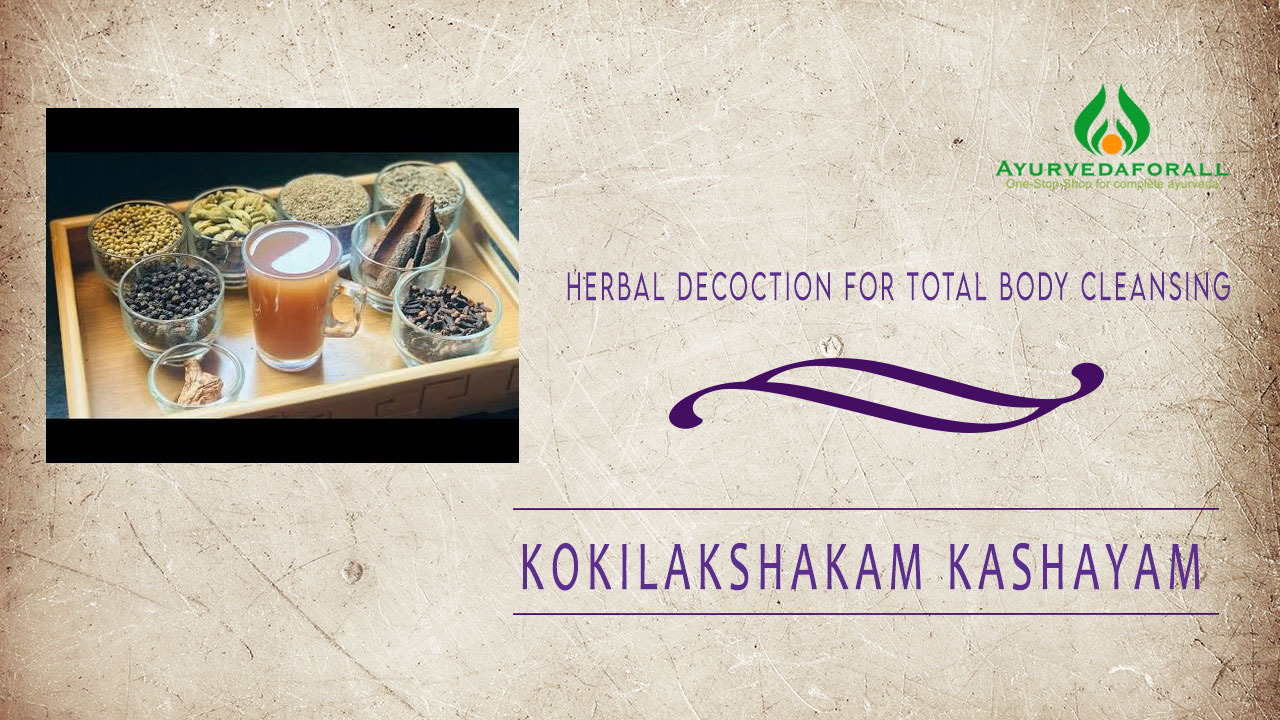

Kokilakshakam kashayam is an Ayurvedic medicine for rheumatoid arthritis and associated ailments.
Benefits of Kokilakshakam kashayam
It is beneficial in conditions like pain and stiffness in the small joints with redness and swelling.
In rheumatoid arthritis it is used to heal the inflammation and improve the function of the affected joints.
It is said that, a person who follows the Pathya (dietary regimen) gets relief in 21 days.
Anzeichen für Kokilakshakam kashayam
Vaatarakta -Rheumatoid arthritis.
Ingredients of Kokilakshakam kashayam
| Marsh barbel | Kokilakshaka | Asteracantha longifolia (L.)/ Hygrophila auriculata (Schumach.) Heine. |
It has various medicinal properties such as anticancer, hypoglycemic, aphrodisiac, antimicrobial, antioxidant, lipid peroxidation, hepatoprotective and hematopoietic activity.
| Heart leaved moonseed | Guduchi
|
Tinospora cordifolia (WILLD.) HOOK.F. & THOMS |
It is effective anti-ulcer drug in action. It is a well-known anti-oxidant and has significant anti-inflammatory property.
AS ANUPANA/PRAKSHEPADRAVYA-TO BE TAKEN MIXED WITH THE KASHAYA
Kana/Pippali
Details zur Herstellung
Kokilakshakam kashayam has two ingredients.
Both these ingredients should be taken fresh and washed well. If not available as fresh herb, take dried form.
Take the prescribed herbs in equal quantity. Cut and crush them into an earthen pot. Now add 16 times clean water into it. Make it boil and then cook in the open vessel with low fire. Reduce the quantity into one by eighth of the initial quantity. Make sure to mix it in between with a wooden spatula. Also, the fire should be kept low to make sure that all the active ingredients in the herbs are absorbed well into the water. Once the quantity is reduced to one by eighth of the initial amount of water, remove the vessel from fire. Squeeze and drain through a clean white cloth. Collect the decoction in a clean vessel and discard the solid waste. Drink the mild warm decoction.
Dosha Dooshya Vorherrschaft mit Roga Margas.
Kokilakshakam kashayam is Pitta kaphahara.
It acts on madhyama and bahir-rogamarga
Dosage and Usage of Kokilakshakam kashayam
Dosierung: zwei Pala.
Verwendung:
Es wird empfohlen, Kashayam auf leeren Magen einzunehmen, sobald die aufgenommene Nahrung gut verdaut und aahaararasa gut gebildet ist.
Verwendung von kashayam mit vorgeschriebenen prakshepadravyas nach dem Zustand der Krankheit und der Patient gibt die besten Ergebnisse meist.
Here the prakshepadravya is Kana/Pippali.
Übungen und Yoga.
Kokilakshakam kashayam targets mainly joints. Vigorous exercises are not allowed in painful conditions.
Only stretching, moderate walking, and mild cardio exercises are advised. Also, specific yogacharya including bhujangaasana, salabhasana, vajrasana is recommended. Range of movement and flexibility must be considered while doing every exercise.
Sookshma sandhi vyayama (warming up small joints) is advised.
Regelmäßige Bewegung trägt dazu bei, die Bioverfügbarkeit der eingenommenen Medikamente und Nahrungsmittel zu verbessern, und führt zu einer positiven Gesundheit.
Yoga kann die Harmonie im Körper und mit dem umgebenden System aufrechterhalten.
Salabhasana
vajrasana
Bhujangasana
Alle Übungen und körperlichen Anstrengungen dürfen nur unter der Aufsicht eines medizinischen Experten durchgeführt werden.
Empfohlene Ernährung und Verhalten
Diät:
- Zu vermeiden sind
Schwere Mahlzeiten und schwer verdauliche Lebensmittel - verursachen Verdauungsstörungen.
Junk Food - stört die Verdauung und verringert die Bioverfügbarkeit des Medikaments
carbonated drinks – makes the stomach more acidic and disturbed digestion
refrigerated and frozen foods – causes weak and sluggish digestion by weakening Agni (digestive fire)
Milk and milk products – increase kapha and cause respiratory problems
Quark - verursacht Vidaaha und damit viele andere Krankheiten
- Noch zu ergänzen
Leichte Mahlzeiten und leicht verdauliche Lebensmittel
Green gram, soups.
frisch gekochte und warme Speisen, die mit Kreuzkümmel, Ingwer, schwarzem Pfeffer, Ajwain usw. verarbeitet wurden
Verhaltensweisen:
Better to avoid exposure to cold.
Avoid sedentary lifestyle as it is one of the main causes of rheumatoid arthritis.
Halten Sie einen regelmäßigen Essens- und Schlafplan ein.
Vermeiden Sie es, Triebe wie Urin, Stuhlgang, Husten, Niesen usw. zurückzuhalten oder zu erzwingen.
Avoid climbing of stairs.
Nebenwirkungen und Kontraindikationen
No known side effects reported
Klassische Referenzen
BHAISHAJYRATNAVALI VATARAKTA ADHIKARA SHLOKA 13
Äquivalente Arzneimittel.
Amrthotharam kashayam
Rasnasunthyadi kashayam
Verfügbare Marken
AVS Kottakal
AVN Madurai
AVP Coimbatore
Vaidyaratnam oushadhasala
Kerala Ayurveda
Forschungsarbeiten
Kokilaksha
GUDUCHI ANTI OXIDANT AND ANTI INFLAMMATORY
The objective of the present work is to study the antioxidant and anti-inflammatory effect of alcoholic and water extracts of T. cordifolia (Willd.) Miers leaves in activated human monocytic THP-1 cells.
- cordifolia (Willd.) Miers extracts exhibited significant amounts of total phenolic and flavonoid content, and LC-MS/MS analyses detected tinosponone, a TC-specific clerodane-derived diterpene. Both types of extracts attenuated AA-induced ROS generation via enhancing catalase enzyme activity in THP-1 cells. Real time PCR and ELISA experiments revealed that the elevated levels of LPS-induced TNF-α was remarkably attenuated in THP-1 cells pretreated with T. cordifolia (Willd.) Miers extracts. Western blot and confocal microscopy showed that the alcoholic extract’s anti-inflammatory activity by attenuating NF-κB translocation into the nucleus in LPS-activated THP-1 cells via the inhibition of IκB degradation in the cytosol.
The findings suggest that T. cordifolia (Willd.) Miers dry leaf extracts possess antioxidant and anti-inflammatory properties via upregulation of antioxidant enzymes and attenuation of NF- κB nuclear translocation in activated human monocytic (THP-1) cells.
doi: 10.1016/j.phymed.2019.152831.
 Deutsch
  English
  Русский
  Français
  Türkçe
  Italiano
  Español